
Soft Secession, Another Unhinged Speech, and the Question of What Scraps Remain of the Federal Government
Waiting for the GOP to lose is a plan the polling does not support, nor does the Heritage Foundation election theft infrastructure.


Author’s note: The academic paper formalizing this publication’s work on state constitutional power, Oppositional Federalism: A Taxonomy of State Constitutional Postures Under Authoritarian Capture, revised July 2026, is free to download on SSRN and under submission at Harvard Law Review. Every download moves the paper up the rankings that legislators, journalists, and state attorneys general use to find new research, and each one supports the work.
Does Donald Trump have about the same poll numbers he has always had? Every major pollster has a current answer. As of mid-July 2026, Quinnipiac has him at 39 percent approval, the Economist and YouGov at 37, ABC News, the Washington Post, and Ipsos at 37, CNN at 36, the RealClearPolitics average at 41, and the Ballotpedia average at 43. The FiftyPlusOne average, which weights every major pollster by quality and recency, reads 37 approve and 59 disapprove, and Nate Silver’s average puts his net approval higher than at any point since mid-April. Gallup has never recorded him above 49 percent in nine years, and no major pollster records him below the mid thirties.
The same clear majority still disapproves, yet between 30 and 40 percent of the country approves of all of it, a share that did not shrink during two impeachments, thirty-four felony convictions, a war, a coup attempt, and everything else. Tens of millions watch all of it and cheer. The fifth path we mapped in May, where things simply work themselves out, requires that support number to collapse. Every pollster on that list shows it not collapsing, which is why we called that path a fantasy.
Is the elected party any closer to leaving him than the voters are? Thomas Massie opposed the Iran strikes and forced the release of the Epstein files, and a Trump-endorsed challenger ended his political career in the May primary. Bill Cassidy voted to convict at the 2021 impeachment trial, and his Louisiana primary ended the same week, the same way. Every Republican still in office watched both races, which is why criticism now takes the form of concern on camera and compliance in the vote. And the reports that institutions are fighting back? They describe something real and small: the same Court that told the administration no on one Guard deployment stripped what remained of the Voting Rights Act in the same term. The headline is occasional. The approval is routine. Waiting for either group to remove him means waiting for people who have already answered.
Do the state governments that base elects still treat elections as binding? In May, we published the state felony case against Elon Musk, and readers in Wisconsin sent hundreds of emails and calls asking the state elections commission to act. On July 9, that bipartisan commission voted five to one that probable cause exists to believe Musk committed felony election bribery with million-dollar checks to voters in the 2025 state Supreme Court race. Mid-decade gerrymanders, voter roll purges, and paid inducements to vote are on the public record, and a governing class willing to use them has announced through conduct that it will lie, cheat, and steal to keep power. Good faith requires reciprocity. Agreements with officials who do not extend it bind one side only, the position of any party whose counterparty does not intend to perform. The structure depends on state capacity, state law, and state courts rather than on anyone’s word.
What about the people inside those states? They are a separate subject from the governments that rule them, and the framework abandons nobody. When questions go to voters directly, those electorates keep choosing what their governments block: Kansas kept abortion rights in its constitution by eighteen points in 2022, six red states expanded Medicaid by ballot initiative over their legislatures, and Missouri passed paid sick leave with nearly 58 percent in 2024 before its legislature repealed it the following spring. Several of these states would plausibly elect different governments under free and fair elections, funded public education, and a legal system that prosecuted fraud on voters the way it prosecutes fraud on investors. Deceiving shareholders carries prison time; deceiving voters remains legal and profitable. Soft secession targets captured governments, protects the people they harm wherever state power reaches, and keeps reentry available for any state that restores free elections.
And the elections that could change any of this? Three facts from July: The administration will not sign other legislation until Congress passes its election bill, the July 16 primetime address was devoted to election integrity, and Trump’s press secretary, asked whether he will accept November’s results, did not answer. The familiar legal reply, that election dates belong to Congress and the country voted on schedule through the Civil War and the Second World War, is accurate and incomplete. Written law constrains a government that accepts constraint, and the record since January 2025 of federalized Guard deployments, immigration raids conducted over state objections, and prosecutions of officials for doing their jobs shows one that acts first and litigates afterward.
Is the federal government still protecting those elections? It ended funding for the multistate system that alerts election officials to security threats and halted CISA’s election support. It has cut thousands of election-focused federal workers. The Justice Department demanded every ballot from Michigan’s largest county from the 2024 election, a demand the state called unlawful, and the administration’s 2027 budget proposal eliminates the federal election security program entirely, which defunds it for the year after the midterms. The interest in foreign help is on the record in his own words: “Russia, if you’re listening,” he said in July 2016, asking Russia to find his opponent’s missing emails, and United States intelligence agencies later determined Russia did exactly that. In October 2019 he told reporters outside the White House that China should investigate the Bidens. The July 16 declassification presented foreign interference as the threat. The system that watched for it is the one his administration defunded.
So the operative question for anything he attempts is who complies. If an order to delay, suspend, or federally supervise a vote ever comes, nothing happens on its own. American elections run through state governments and thousands of county and municipal offices: clerks print ballots, secretaries of state certify, governors sign, and federal agencies have almost no role in that sequence. In Republican trifectas whose officials already comply with instructions that lack legal basis, parts of an attempt could take effect. In states that refuse, none of it has to. The condition of states diverging that far inside one federal system is the collapse of a nation and it could be just a few months away.
In August 2025, The Existentialist Republic published a viral article on soft secession, the term we outlined as states that reduce cooperation with a lawless federal government and build parallel institutional and financial capacity so the people inside them can function and thrive anyway. The idea developed into a formal academic framework naming five tiers of state posture, from ordinary cooperation through uncooperative federalism, soft secession, and oppositional federalism to constitutional non-compliance, each grounded in two and a half centuries of Supreme Court doctrine. Brookings called the framework provocative.
What is the whole structure for? Harm reduction is a public health term: policies that reduce the damage of an ongoing harm without requiring the harm to end first. Naloxone reduces overdose deaths among people still using; needle exchanges reduce disease transmission among people still injecting.
Soft secession performs the same function for governance. It reduces the damage a captured federal government can inflict on people inside opposition states, without waiting for the federal government to be repaired and without ending the union. A state that builds its own pharmaceutical purchasing protects patients now. A state that prosecutes federal officers who commit assaults and homicides under state law protects communities now. Interstate compacts on healthcare, climate, labor, and reproductive care protect people across state lines now. What reads as legal impossibility is usually political choice.
Reversibility separates harm reduction from rupture. The structure runs on ordinary legislation, executive orders, and prosecutorial decisions, so each piece reverses the same way: an ended data-sharing agreement restarts with a signature. Hard secession forecloses return and raises the question of armed conflict on the day it is declared. Soft secession is a posture a state can maintain for a decade and reverse in a single legislative session.
Where this leads depends on which of three endings occurs: the federal center recovers and the states reintegrate, the states renegotiate into something looser that provides peace and a shared market, or the center collapses and the states separate in an uncontrolled way. Soft secession is built for the first two and lowers the human cost of the third. If the pushback works, we restore the union we have. If it fails, the architecture for what comes next already exists.
The renegotiation ending already exists in working form. The European Union runs a shared market of twenty-seven sovereign countries and roughly 450 million people, whose members keep their own criminal law, police, and constitutions, with no central executive able to send armed personnel into a member state against its will. The fourth path we mapped in May looked like this: the Pacific states coordinate on climate and labor, New England pools healthcare, the Great Lakes states negotiate water as a bloc, and eventually somebody calls a constitutional convention and we write down what we have already become. Roughly two hundred interstate compacts already function as treaties between states in everything but name. The European ending, if the American one fails, requires deliberate construction and negotiated terms. The Soviet ending requires nothing at all. Drift gets us there as surely as malice does.
When did the Soviet Union actually collapse? It survived Stalin and survived Brezhnev. It dissolved under Mikhail Gorbachev, a reformer who took office in 1985 to save the system and presided over its collapse, because the pressures pushing the republics apart had built for decades and his reforms removed the coercion containing them. Tocqueville described the pattern in 1856: the most dangerous period for a bad government usually begins when it starts to reform itself.
Applied here, a period of severe structural danger may come after this administration rather than during it. A successor who loosens control inherits the powers this White House acquired, and loosening reveals what besides force kept it intact. Whoever comes next ratifies the acquisitions of this era whether they exercise them or not. The transition is the fragile phase, and preparing for it is what state capacity building is for.
What decided the post-Soviet outcomes? Preparation. Estonia, Latvia, and Lithuania had organized popular fronts, functioning civic institutions, and living memory of independent statehood when the collapse came, and became democracies and, by 2004, European Union members. Regions without those institutions got the Nagorno-Karabakh war and a civil war in Tajikistan that killed tens of thousands. Czechoslovakia demonstrates the alternative: a negotiated separation, completed January 1, 1993, that produced no armed conflict and two European Union members. Grievance existed in all of these cases; functioning institutions beneath the failing center existed only in some, and the difference shows in the death tolls.
American states differ from Soviet republics in almost every particular, and the comparison makes one point: when a center weakens, through collapse or through reform, outcomes for ordinary people depend on how much working governance exists underneath. Built early, that governance protects people through the authoritarian period. Present at the transition, it makes a Czechoslovak ending more likely than a Soviet one, and keeps possible the outcome neither managed: a recovered federation states rejoin because it serves their people.
If you find this work of value and want it to continue, we need subscribers. The model legislation, the academic contributions, the activist calls to action, the educational books and booklets, it all takes time, energy, and resources that are largely funded through subscriptions. We paywall nothing because this is the work of fighting fascism. Don’t let this be the reason you skip a meal or miss rent, but if you can contribute then you’re the reason this all exists for millions of activists.
The framework mentioned above has a primer for the general public: Intro to Soft Secession, a booklet that is a 25 to 30 minute read. Readers have purchased physical copies and handed them to everyone at their Indivisible meeting, or to every house on their block. The PDF is a $0.00 download, and you can print as many as you want, with a different cover that says Strong States or Oppositional Federalism if soft secession is a bit much for where it is going. The idea inside is simple, and it fits the “coup where you can” mindset: take power at the lowest level available, expand it to do as much good as possible, and keep climbing, democracy on the offensive.
Click this sentence to purchase a physical copy of Intro to Soft Secession
Click this sentence for the $0.00 PDF in our BMAC store

Activist Call To Action
California made seizing ballots a felony. The Existentialist Republic published a model bill that takes what California did and multiplies it by ten, for all 50 states including California, at cmarmitage.substack.com/p/california-is-making-ballot-seizure. If you already called or emailed when that article ran, use a different method this time: fax it to every state legislative office in your state. A fax gets attention because it prints on paper inside the office and somebody has to pick it up. Faxzero.com sends five free faxes a day with no account, and its paid option, a few dollars per fax, sends up to 25 pages, enough for the entire bill to print page by page. Fax numbers are on each member’s official page, and your own legislators are at openstates.org/find_your_legislator. Send this with it:
To the office of [legislator name]: I am a constituent at the address below. I am asking you to introduce the Election Protection and Accountability Act, the model election protection bill published by The Existentialist Republic at cmarmitage.substack.com/p/california-is-making-ballot-seizure, and to request a special session if our legislature has adjourned. Please reply with your position. [Name, street address, city]
The Existentialist Republic Library
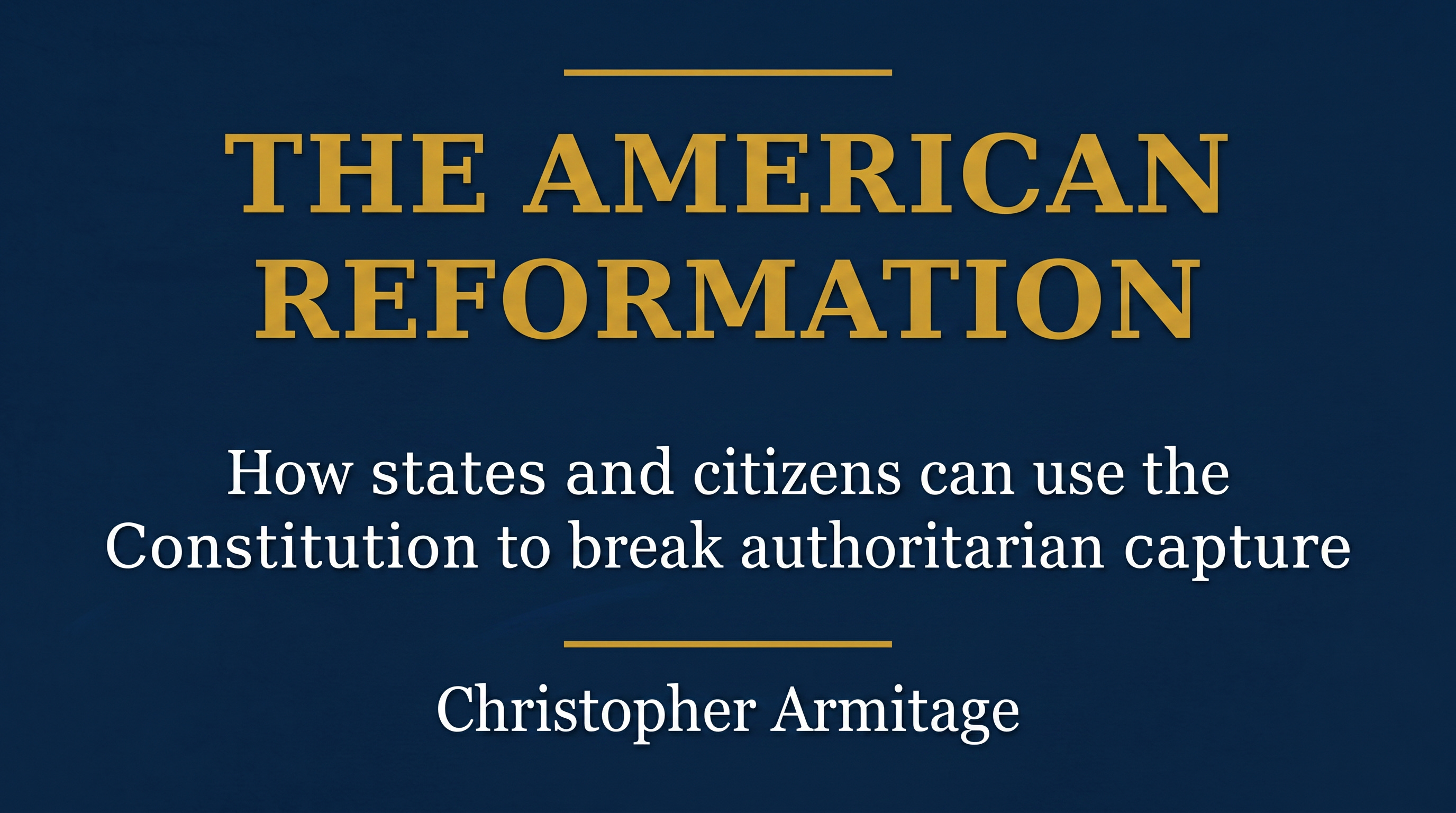
You can get a free PDF of the book in the BMAC shop for $0.00 by clicking on this sentence.
More reading
Conservatism: America’s Personality Disorder — physical copy / free download
Intro to Soft Secession — physical copy / free download
Oppositional Federalism and You — physical copy / free download
Toppling Tyrants: A Field Guide to Dismantling American Fascism — physical copy / free download
Grab Them By The E.A.R.R.: How to Get Politicians to Do What You Want — physical copy / free download
More Free Downloads:
Soft Secession: 100 Policies That Pass
Being Dangerous: Go From Activist to Operative
All Four Completed Model Legislation Bills
The Opposition Guide to Tax Warfare
Six-Panel Soft Secession Brochure
Sent the message to my state rep., my state sen., my federal rep., and my two federal senators. I think I sent it to some people before—didn’t you send the information out once before? Anyway, I never heard back from anyone, so sent it again. Thanks for giving us concrete tasks to do. I don’t always have time or energy to do them, but I try to follow through as often as possible. I really believe in what you are doing.
Excellent summary of where we are, Christopher.
I think we are a hopelessly divided nation. The thought of where we would be now if Lincoln had simply let the South secede keeps coming to mind.