
Republicans Hate Freedom, Justice, and the Constitution

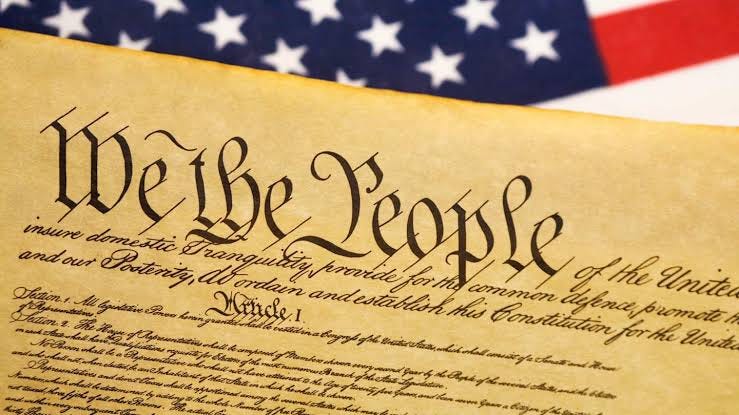
There is a word for what happens when people swear an oath to a document and then spend their careers destroying it. We are going to walk through several amendments to the Constitution, amendment by amendment, clause by clause, subsection by subsection, and examine what the Republican Party, the Trump administration, the Roberts Court, the Federalist Society, and the Heritage Foundation have done to each one.
The people who did this have spent decades telling us they are the true defenders of the Constitution. They called themselves originalists. They said the only honest way to read the document is the way the founders intended it. That turns out to be a lie, and the evidence is right here in the amendments themselves. The founders had lived under a king, a royal family, and an aristocracy. They knew exactly the flaws of that system and had a revolution to try and create something better. Something fair and just, where the people were free from tyranny.
The ACLU published a plain-language translation of the Bill of Rights that makes each amendment readable for anyone. We use some of it here, with full credit to them.
AMENDMENT 1
Congress shall make no law respecting an establishment of religion, or prohibiting the free exercise thereof; or abridging the freedom of speech, or of the press; or the right of the people peaceably to assemble, and to petition the Government for a redress of grievances.
The ACLU: Congress cannot make any law that establishes a religion, stops you from practicing a religion, or stops you from saying what you think. It cannot stop the press from printing what it wants. You can gather peacefully with others to protest. And you can send a petition to the government asking it to change something.
On the freedom of religion: James Madison wrote that “the full and equal rights of conscience” shall “in no manner, or on any pretext” be infringed. He had watched Virginia imprison Baptist ministers for preaching without a government license. The administration promoted Trump-branded Bibles. Republican-controlled states passed laws requiring Bible curriculum in public schools in Louisiana, Oklahoma, and elsewhere. Establishment Clause challenges are pending.
On freedom of speech: The administration circulated a government-wide list of hundreds of banned words and deleted hundreds of terabytes of publicly funded research from government websites. The administration detained Mahmoud Khalil, a Columbia University graduate student and legal permanent resident, arguing that his protected political speech about Palestinian human rights threatened U.S. foreign policy. An immigration judge threw the case out. The government appealed and a federal appeals court ruled against Khalil in January 2026. ICE detained Rümeysa Öztürk, a Tufts doctoral student, after revoking her visa for writing an op-ed in her campus newspaper. A national security memorandum identified “anti-federalism, anti-capitalism, and anti-Christianity” as domestic terrorism indicators, targeting political beliefs rather than actions.
On freedom of the press: The administration banned the Associated Press from the White House press pool. The FBI raided the home of Washington Post reporter Hannah Natanson in January 2026; the Knight First Amendment Institute called it “highly unusual and aggressive.” Federal agents arrested journalists Don Lemon and Georgia Fort overnight in Minneapolis for covering ICE operations, after a federal magistrate had already declined to issue warrants. Congress revoked $1.07 billion in funding from NPR, PBS, and more than 1,500 local stations. The United States fell to 57th place out of 180 countries on the World Press Freedom Index, its lowest ranking since the index began in 2002.
On the right of association: the administration issued executive orders targeting WilmerHale, Perkins Coie, and Jenner & Block because they had represented Trump’s opponents or the investigators who pursued him. Federal judges issued permanent injunctions blocking all three orders, ruling each one a violation of First Amendment rights. Judge Richard Leon wrote that they created “a constitutional harm” by chilling speech and legal advocacy.
Madison warned that “it is proper to take alarm at the first experiment on our liberties.”
AMENDMENT 4
The right of the people to be secure in their persons, houses, papers, and effects, against unreasonable searches and seizures, shall not be violated, and no Warrants shall issue, but upon probable cause, supported by Oath or affirmation, and particularly describing the place to be searched, and the persons or things to be seized.
The ACLU: Nobody can search your body, your house, or your papers and belongings unless they can prove to a judge that they have a good reason. A judge must issue a warrant that specifically describes the place to be searched and the person or thing to be taken.
No amendment grew more directly from lived experience. The Fourth Amendment was the founders’ answer to general warrants and writs of assistance, which authorized officials to search anyone, anywhere, for any reason, without naming what they were looking for. John Adams wrote that James Otis’s 1761 argument against these writs was “the first scene of the first act of the opposition to the arbitrary claims of Great Britain. Then and there the child of independence was born.”
What we are watching now did not start in 2025. After September 11, Section 215 of the PATRIOT Act gave the government authority to collect any records deemed relevant to a terrorism investigation. The executive branch used it to force every major American telephone company to hand over the phone records of every customer, every day, for years, without telling Congress, the courts, or the public. The Privacy and Civil Liberties Oversight Board later found the program made no concrete difference in preventing a single terrorist attack. Section 702 of FISA, passed in 2008, allowed warrantless collection of Americans’ communications swept up while targeting foreigners abroad. The FBI conducted 3.4 million warrantless searches of Americans’ data under Section 702 in 2021 alone, including searches of Black Lives Matter protesters, members of Congress, journalists, and political donors. Section 702 expires April 19, 2026. Trump wants it renewed.
The current administration inherited that infrastructure and merged it with something new. DOGE received full, unrestricted access to all unclassified federal agency records without a warrant, probable cause, or specified target. DOGE operatives entered Social Security systems without legal authority, exposed the bank account numbers, health records, and immigration status of millions of Americans, and the DOJ acknowledged misconduct. A federal court ordered the data deleted. The Supreme Court stayed that order. Palantir received combined access to IRS, DHS, Social Security, and Medicaid databases to build integrated profiles on individual Americans. ICE obtained taxpayers’ names and home addresses from the IRS for deportation targeting. DHS purchased bulk cell phone location data without warrants. The administration fired the entire oversight board responsible for keeping surveillance accountable. What changed is not the existence of the surveillance state. What changed is who it is pointed at and who is left to stop it.
In September 2025, the Supreme Court’s six-justice majority stayed a lower court order that had blocked immigration raids in Los Angeles after a federal judge found agents were stopping people based on race. Justice Kavanaugh wrote a concurrence holding that while apparent ethnicity alone cannot justify a stop, speaking Spanish, working day labor, and being in a neighborhood with a high undocumented population could together constitute reasonable suspicion. What followed are now called Kavanaugh stops: federal agents detaining people, including U.S. citizens and legal residents, because of how they looked and where they worked. Lawyers presented courts with evidence that agents had detained and in some cases brutalized people even after those people asserted lawful status. Kavanaugh later buried a partial walkback in a footnote in an unrelated case. The CBP chief responded by declaring that agents can engage in racial profiling regardless, and the stops have continued at an accelerating pace. The Court opened the door. The administration walked through it and has not looked back.
Otis said of general warrants: “Every man may reign secure in his petty tyranny, and spread terror and desolation around him.” He was warning us.
AMENDMENT 5
No person shall be...deprived of life, liberty, or property, without due process of law.
The ACLU: The government can’t take away your life, your freedom, or your property without following fair legal procedures.
The due process clause says “person.” Not citizen. The founders made this choice deliberately. They understood that a government empowered to strip rights from any defined category of people would expand that category until no one was safe. The Supreme Court confirmed this going back to 1903. Due process belongs to every human being on American soil.
That protection has been systematically dismantled for Americans too. The Reconstruction Congress passed 42 U.S.C. § 1983 in 1871 to make government officials personally liable for constitutional violations. The text says “every person.” No exceptions written in. The Supreme Court invented qualified immunity in 1967 and turbocharged it in 1982, creating a standard that shields government officials from accountability unless a prior court ruled on nearly identical facts. Courts can sidestep even that by granting immunity first, ensuring the precedent never gets established. A ruling in one jurisdiction means nothing in another. And this Court has demonstrated, in Dobbs and Shelby County among others, that settled precedent is optional when six justices want a different answer. Justice Thomas has written publicly that the doctrine has no grounding in the common law as it existed when Congress passed Section 1983. It is not in the Constitution. It is not in the statute. The Roberts Court invented it and has spent decades protecting it. In Heien v. North Carolina in 2014, the Court ruled 8-1 that a stop and search based on an officer’s mistaken understanding of what the law actually says is still valid and any evidence found is still admissible. Civil asset forfeiture lets the government seize your cash, your car, or your house without charging you with a crime. The property is accused, not you; you must sue to recover it, often bearing the burden of proving it was not connected to any illegal activity. No hearing before the seizure. No conviction required after.
The administration sent more than 260 Venezuelans to CECOT, a mega-prison in El Salvador, under a wartime law from 1798, without hearings, trials, or any opportunity to challenge removal. A Bloomberg investigation found approximately 90 percent had no U.S. criminal record beyond traffic or immigration violations. The Supreme Court ruled unanimously this violated Fifth Amendment due process. Four days later, Trump posted publicly: “We cannot give everyone a trial.” The Supreme Court ruled again on May 16 that 24 hours notice “devoid of information about how to exercise due process rights” did not meet constitutional standards. The administration dismissed active immigration court cases to funnel people into expedited removal, bypassing judges entirely. ICE began arresting people who showed up to required check-ins, punishing compliance with the law. In February 2026, a new rule gutted the Board of Immigration Appeals, eliminating appellate review of immigration decisions and removing the primary mechanism by which wrongful deportation orders get caught before they execute. More than 290,000 people went through ICE detention through mid-October 2025, a 19 percent increase over the prior year. Federal courts issued hundreds of writs of habeas corpus. The administration ignored them. No official has been jailed. No official has been sanctioned.
WHAT THE AMENDMENTS DO NOT COVER
The most structurally dangerous actions of this period do not map to a single amendment. Early in 2025, the administration froze approximately $1 trillion in congressionally approved grants and loans, money Congress had already appropriated and the executive had no constitutional authority to freeze. Courts blocked it. The Supreme Court ordered the administration to release nearly $2 billion in foreign assistance funds it had withheld. Article I of the Constitution gives Congress the power of the purse. The administration proceeded as if it does not.
The administration openly defied federal court orders. Chief Judge James Boasberg ordered deportation planes to turn around mid-flight. The planes continued to El Salvador. Secretary of State Rubio reposted “Oopsie” on social media. Boasberg found probable cause for criminal contempt. The Supreme Court unanimously ordered the administration to facilitate the return of a man it had wrongfully deported to a Salvadoran prison. The Secretary of Homeland Security said publicly he would never be allowed back. At least 39 judges from five administrations ruled against executive overreach in the first months of the second term; more than 350 lawsuits were filed; and in more than 700 immigration cases, at least 225 judges found the detention policies likely violated the Constitution.
Republicans in the House buried a provision on page 544 of the 1,082-page budget bill that would prohibit federal courts from using appropriated funds to enforce contempt citations. Erwin Chemerinsky, dean of UC Berkeley School of Law, wrote: “Without the contempt power, judicial orders are meaningless and can be ignored. There is no way to understand this except as a way to keep the Trump administration from being restrained when it violates the Constitution or otherwise breaks the law.” Trump called for the impeachment of Judge Boasberg. Chief Justice Roberts issued a public statement making clear that judicial impeachment is not the appropriate response to disagreement with a court ruling.
SO. IS TREASON THE RIGHT WORD?
Article III, Section 3 of the Constitution defines it precisely: “Treason against the United States, shall consist only in levying War against them, or in adhering to their Enemies, giving them Aid and Comfort.”
The founders wrote that definition directly into the Constitution itself, not into a law, into the document, because they had watched treason charges used as a political weapon in England for centuries. In Federalist No. 43, Madison wrote that “new-fangled and artificial treasons” had been “the great engines by which violent factions, the natural offspring of free Governments, have usually wreaked their alternate malignity on each other.” The founders built a constitutional barrier specifically to stop powerful people from labeling their political opponents traitors and using the charge to destroy them. The definition is narrow on purpose.
Levying war against the United States. Adhering to its enemies. Giving them aid and comfort. Applied strictly, as the founders intended, that is a high bar. What we have documented here may not clear it.
But the founders also understood something else. They understood that a constitutional government can be destroyed without a single shot fired, through the systematic dismantling of the legal structures that make it function. Through defying courts. Through ignoring congressional authority. Through concentrating power in a single executive and insulating that executive from accountability. Through building a surveillance apparatus that would let future governments identify, track, and punish anyone who objects.
Federal law addresses this directly. 18 U.S.C. § 2384 defines seditious conspiracy as conduct by two or more persons who conspire to overthrow, put down, or destroy by force the Government of the United States, or to oppose by force the authority thereof, or by force to prevent, hinder, or delay the execution of any law of the United States.
Not by force of arms, necessarily. By force of coordinated institutional power. By force of a captured judiciary, a compliant legislature, through disinformation paid for by hostile foreign nations, by influence peddling political parties, by an executive willing to defy court orders and a Supreme Court willing to look away while it does.
Seditious Conspiracy. We should call it what it is. Often.
Toppling Tyrants: A Field Guide to Dismantling American Fascism — physical copy / free download
Grab Them By The E.A.R.R.: How to Get Politicians to Do What You Want — physical copy / free download
Conservatism: America’s Personality Disorder — physical copy / free download
Intro to Soft Secession — physical copy / free download
Oppositional Federalism and You — physical copy / free download
Free downloads:
Being Dangerous: Go From Activist to Operative
Soft Secession: Policies That Pass
All Four Completed Model Legislation Bills
The Opposition Guide to Tax Warfare
Six-Panel Soft Secession Brochure
Prosecution Memo: Jonathan Ross
Find any official in any state at openstates.org. Find your state attorney general at usa.gov/state-attorney-general. Find mutual aid near you at mutualaidhub.org.
Democracy merch and the full library at The Existentialist Republic.
Amendments six through ten, covering the rights the founders built around criminal prosecution, cruel punishment, and the limits of federal power, are examined in Part Two.
Exactly. They hate freedom because it doesn’t allow them to control, they hate justice because they hate consequences for their actions, and they hate the Constitution because it doesn’t allow them to careen wildly off the course of the founding fathers (anti-monarchy).
Why have Republicans and the conservative Supreme Court decided that the Constitution’s most fundamental protections are now somehow superfluous?
The First Amendment — freedom of speech and expression — is defended only when politically convenient.
The Fourth Amendment’s protection against government intrusion is steadily weakened as privacy rights erode.
The Fifth Amendment’s guarantee of due process, the bedrock of American justice, is increasingly treated as an obstacle rather than a principle.
Republicans and the conservative Supreme Court appear willing to sideline these amendments, not because the Constitution has changed, but because political fear has.
They have chosen loyalty and power over principle — too afraid to stand up to one man rather than uphold the oath they swore to the American people.
The Constitution was designed to restrain power, not surrender to it.
When those entrusted to defend it declare its protections expendable, they are not interpreting the Constitution — they are abandoning it.
Americans must ask: if our leaders treat the First, Fourth, and Fifth Amendments as optional, what rights disappear next?
It is time for the people to stand up and be counted !!!