

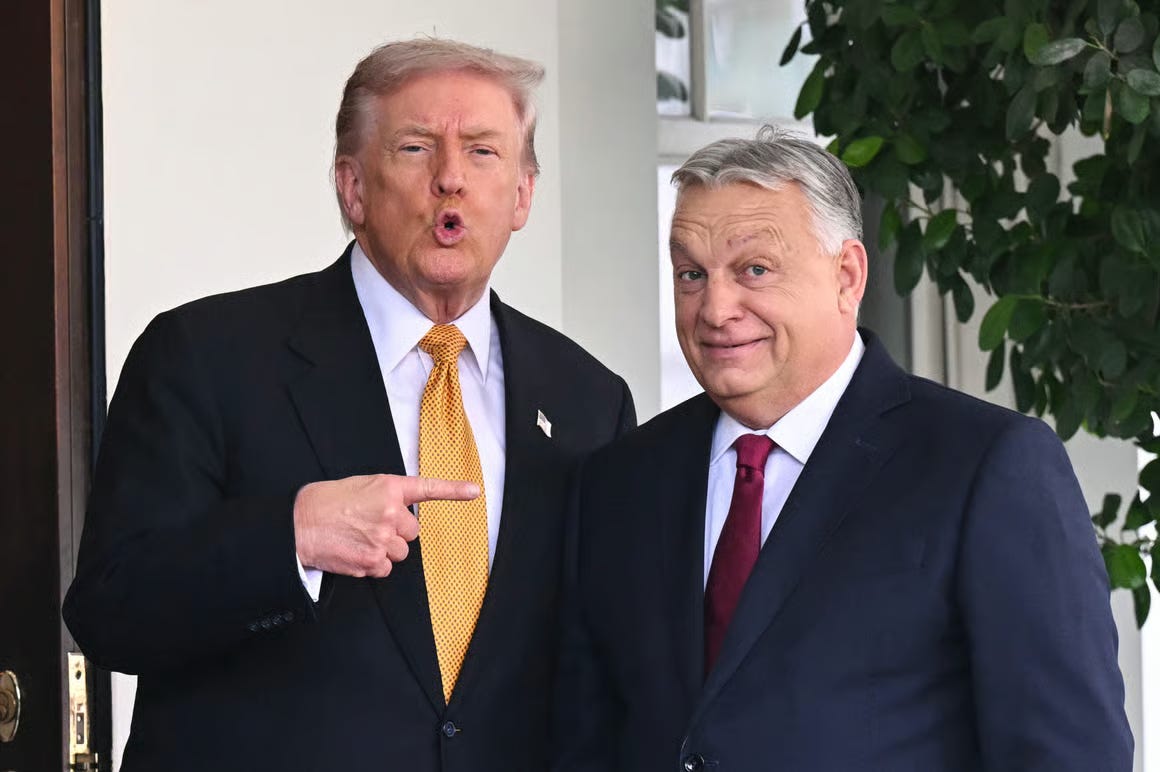
When the Supreme Court struck down the IEEPA tariffs in February, Bright Line Watch co-director John Carey told NPR the ruling showed the administration had not fully captured its most important set of referees. That framing treats a court ruling as evidence of a functioning check. Princeton political sociologist Kim Lane Scheppele spent years in Hungary watching Orbán’s government get checked by courts, condemned by the EU, and protested by hundreds of thousands of citizens while consolidating permanent structural power underneath all of it. She has a name for what that process looks like from inside: autocratic legalism.
Scheppele defines it as the use of legal forms to dismantle the constitutional architecture that makes democratic accountability possible.¹ The critical insight is that the method depends on each individual action appearing defensible in isolation. Lowering a judicial retirement age looks like good governance. Requiring proof of citizenship for voter registration looks like election security. Firing agency heads looks like executive management. No single move announces itself as the thing it actually is, which is why standard democratic checklists miss it until the transformation is complete.
The operating mechanism runs three ways simultaneously. Javier Corrales, studying Venezuela under Chávez, identified them first: the use of law to create new executive powers, the abuse of law by changing how existing statutes get interpreted to serve consolidation, and the non-use of law by simply declining to enforce rules that constrain executive authority.² The three moves work together. Use generates the legal architecture. Abuse extracts maximum power from it. Non-use trains every institutional actor watching that the cost of resistance is higher than the cost of compliance.
The tariff case illustrates all three in a single sequence. The administration used IEEPA to impose sweeping tariffs, asserting emergency authority Congress never explicitly granted. Lower courts ruled the tariffs illegal in May 2025. Rather than pause collection, the administration asked the Supreme Court to let the tariffs keep running during appeal, and the Court agreed. For nine months, $166 billion moved from American businesses to the federal government under authority two courts had already ruled unlawful. When the Supreme Court finally ruled against the administration in February 2026, it covered only the IEEPA tariffs, leaving Section 232 and Section 301 authorities untouched. The administration enacted replacement tariffs under Section 122 the same afternoon.³ The $166 billion remains with the government. CBP told the Court of International Trade it cannot process refunds at this scale, citing 53 million entries and 330,000 importers, and asked for 45 days to build a system that does not yet exist.⁴ Individual businesses now file lawsuits to recover money the Supreme Court ruled was illegally taken from them, while the administration launches Section 301 investigations to build the factual predicate for the next round of tariffs through the legal doors the ruling left open.³
That sequence is not a loss followed by a pivot. It is use, abuse, and non-use operating as a coordinated whole. John Roberts and the Federalist Society judges literally go to the same parties and planning meetings as the Republican Party. They actively coordinate and understand the importance of feeding a bland appearance of “fighting back” for Hungarian style controlled opposition to have any effect. They praise and are running off the same Project 2025 written by Hungarian autocrats and the same Viktor Orban who was a keynote speaker at U.S. Conservative conferences.
The administration collected $166 billion under illegal authority, identified through litigation which legal authorities survive judicial scrutiny, replaced the struck tariffs immediately using those authorities, and obstructed the return of money it was ordered to refund. The Court’s ruling changed the legal hook. It did not change the policy outcome, the revenue outcome, or the structural outcome. What it changed is that future tariff actions now run through validated legal channels, making them harder to challenge.
Scheppele describes the Frankenstate as the result of assembling legal instruments borrowed from functioning democracies and repurposing them to produce outcomes those instruments were designed to prevent.¹ Section 232 and Section 301 are legitimate trade authorities that presidents have used for decades. The administration now deploys them not because the statutory conditions they require have been met in good faith, but because the tariff litigation identified them as the surviving doors. The legal form is genuine. The purpose is not. That gap, between the appearance of legal compliance and the reality of what the compliance produces, is exactly what autocratic legalism describes and exactly what makes it so difficult to interrupt through litigation alone.
Carey is not wrong that the Court ruled against the administration. He is measuring at the wrong level. The structural question is not whether any particular action got blocked. It is whether the conditions for democratic accountability advanced or retreated. After a year of litigation and a Supreme Court ruling hailed as a major check on executive power, tariffs are still in effect, the replacement authorities are legally cleaner than the ones they replaced, $166 billion in illegally collected money has no clear path back to the businesses that paid it, and the administration holds a court-produced roadmap for every future trade action it wants to take. That is the structural outcome.
The facts do not support calling that a win. They don’t support saying “we are stopping the fascist coup.”
We can win but believing propaganda that wildly overstates assertions of meek and scattered internal opposition serves to aid the enemies of democracy rather than it’s defenders. The article linked in this text covers the strategies being employed and factually substantiates their presence.
We are on offense and we are here to win.
So how do we do that mindset?
Every single resource below is available FREE, that means answering questions such as:
“How do I help get other people to organize and fight back?”
“How do I get politicians to do what I want?”
“What’s the exact playbook being used and what playbook defeated it?”
“What can I personally do that will actually cause a real and observable impairment to the atrocities I see filling my news feed?”
Take a look and pick up the tools for destroying this fascist machine before it takes us all down with it.
Toppling Tyrants: A Field Guide to Dismantling American Fascism — physical copy / free download
Grab Them By The E.A.R.R.: How to Get Politicians to Do What You Want — physical copy / free download
Conservatism: America’s Personality Disorder — physical copy / free download
Intro to Soft Secession — physical copy / free download
Oppositional Federalism and You — physical copy / free download
More Free downloads:
Being Dangerous: Go From Activist to Operative
Soft Secession: Policies That Pass
All Four Completed Model Legislation Bills
The Opposition Guide to Tax Warfare
Six-Panel Soft Secession Brochure
Prosecution Memo: Jonathan Ross
Find any official in any state at openstates.org. Find your state attorney general at usa.gov/state-attorney-general. Find mutual aid near you at mutualaidhub.org.
Democracy merch and the full library at The Existentialist Republic.
Works Cited
¹ Scheppele, K. L. (2018). Autocratic legalism. University of Chicago Law Review, 85(2), 545–583. https://chicagounbound.uchicago.edu/uclrev/vol85/iss2/2
² Corrales, J. (2015). Autocratic legalism in Venezuela. Journal of Democracy, 26(2), 37–51.
³ Wikipedia contributors. (2026). Learning Resources, Inc. v. Trump. Wikipedia. https://en.wikipedia.org/wiki/Learning_Resources,_Inc._v._Trump
⁴ BDO. (2026, March). IEEPA tariff refunds: Frequently asked questions. https://www.bdo.com/insights/tax/ieepa-tariff-refunds-frequently-asked-questions
Sorry I'm little long winded here:
We keep being told everything is “winning” while our rights are steadily chipped away, court rulings are ignored, and Congress is treated like an inconvenience instead of a co-equal branch of government. This is not strength — it is narrative control.
Donald Trump’s strategy has always relied on repeating success loudly enough that supporters believe it, even when courts block policies, legal limits are tested, or constitutional norms are pushed aside.
By framing judges, lawmakers, and the press as enemies, accountability itself becomes the target. When leaders convince people that institutions cannot be trusted, they gain more freedom to act without restraint.
The Constitution was designed specifically to prevent this.
The courts exist to check executive power.
Congress exists to represent the people. And citizens exist as the final safeguard when leaders overreach.
If we believe our rights are being taken away or democracy is being weakened, the answer is not silence or resignation — it is action.
Vote in every election, not just presidential ones.
Call and pressure elected officials so they cannot pretend the public is indifferent. Support legal challenges that defend constitutional limits. Show up peacefully and visibly so leaders understand there is a political cost to ignoring the rule of law. Organize locally, inform others, and refuse to let misinformation replace reality.
Democracy does not disappear overnight. It erodes when people assume someone else will defend it.
The question is no longer whether leaders will test the limits of power — history shows they always do.
The question is whether citizens will use the power they already have to stop it
We keep being told everything is “winning” while our rights are steadily chipped away, court rulings are ignored, and Congress is treated like an inconvenience instead of a co-equal branch of government. This is not strength — it is narrative control.
Vote — especially in “smaller” elections
Midterm elections often matter as much as presidential ones.
Local races — governors, attorneys general, state legislators, school boards — directly affect policy implementation.
Many major national shifts started with local electoral changes.
Contact elected officials (it matters more than people think)
Officials often change positions when they see sustained constituent concern — especially from voters in their district.
Support court challenges
Many executive actions in U.S. history have been limited through lawsuits brought by states or advocacy groups.
Peaceful protest and public pressure
Historically, peaceful mass participation has influenced policy across parties and eras:
Stay informed — across multiple sources
Well-informed voters are harder for any political leader to mislead.
Organize locally
Local organizing builds long-term political influence more effectively than online debate alone.
Protect democratic norms legally
The U.S. system assumes citizens actively participate in oversight.
The key idea
The Constitution doesn’t rely only on institutions — it relies on active citizens. Courts, Congress, and elections respond when enough people consistently engage.
The level of financial corruption and the accompanying lies? What we're seeing right now is mind-boggling.
The Trump family business is a master class in graft, nepotism, and depravity. How do we get states to pursue fraud cases more aggressively?