

Warsaw, December 1939. German forces had occupied Poland for three months. On the night of December 26, two drunk German soldiers died in a shootout at a snack bar on the edge of the city. The Ordnungspolizei responded by pulling 120 men and boys from their homes in the surrounding neighborhood of Wawer, holding a sham trial that lasted minutes, and shooting 107 of them. The youngest was twelve. Some were visiting family for the holidays. None had anything to do with the deaths at the snack bar.
This was the first large mass execution of Polish civilians under German occupation. It would not be the last.
A year later, a Polish youth resistance cell formed inside the Home Army and named itself after the village where the massacre happened; Wawer. They called their work “small sabotage.” The goal was to keep the occupation from ever feeling normal. To make the Germans nervous, the collaborators afraid, and the poles feeling inspired to continue fighting against their occupiers. Their tactics included graffiti, Nazi propaganda posters altered overnight so a triumphant announcement about advances into the Soviet Union carried a new date, 1812, reminding Warsaw what happened to the last army that tried to occupy. Polish flags raised on Polish national anniversaries in places where Polish flags were forbidden. Collaborators named in underground leaflets that circulated through apartment buildings before the Gestapo could collect them.
There were stink bombs in German movie theaters so the occupiers could not enjoy a night out. Fire alarms pulled at German public events. German propaganda loudspeakers hijacked mid-broadcast and used to play Polish messages before the crews could cut the power. Tires quietly flattened on the cars of SS officers eating in the last restaurants in Warsaw where the food still existed. Streetlamps across the city marked with the words Nur für Deutsche, only for Germans, a promise that the people who hanged Poles would themselves hang from those same lamps. Fake editions of Nazi-run newspapers printed and sold on Kraków sidewalks before the real editions reached the newsstands.
In February 1942, an 18-year-old named Maciej Dawidowski climbed the Copernicus monument in broad daylight, in full view of the police headquarters, and unscrewed the German plaque the Nazis had bolted over the Polish inscription claiming Copernicus for the German nation. The plaque fell into the snow. The underground press made sure every Pole in the city knew. The Germans retaliated by dismantling the statue of Jan Kiliński, a Polish insurgent hero, and hiding it in the vaults of the National Museum. Wawer’s response was to paint on the museum walls the words People of Warsaw, I am here, Jan Kiliński, and then to bolt a new plaque to the base of the Copernicus statue reading,
“For removal of the Kiliński statue, I am extending winter by two months. Kopernik.”
This is what the teenagers of occupied Warsaw did while the Nazi army held their country. They made the occupation look ridiculous. They also obstructed and sabotaged. And they did it knowing that Elżbieta Zahorska had been executed in 1939 for tearing down a single poster.
Their first graffiti campaign, started around Christmas 1940, painted two words on walls across Warsaw. “Pomścimy Wawer.” We will avenge Wawer. The Germans painted over it. Wawer painted it again. Over time, to move faster and get caught less often, they shortened the phrase to two letters. P and W. Eventually they fused the letters into a single symbol, an anchor shape that could be slashed onto a wall in two seconds. That symbol became the Kotwica, and the Kotwica became the emblem of the entire Polish resistance. Every act of defiance in occupied Poland, for the rest of the war, traced back to a graffiti campaign started by teenagers who wanted to remember 107 murdered neighbors.
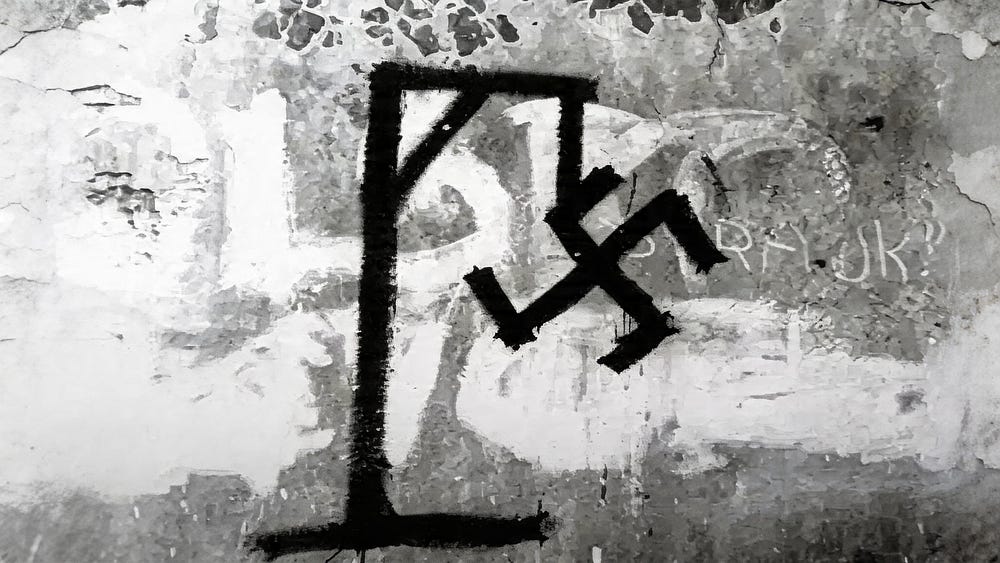
In April 1942, the day before Hitler’s birthday, Wawer distributed roughly two thousand posters across Warsaw and painted this image on walls throughout the city. A swastika hanging from a gallows. The Nazis controlled the country. They ran the police, the courts, the trains, the press, and the food supply. Wawer did it anyway.
A lie told by occupiers to the occupied says that resistance only makes sense when it leads to certain, clear, and complete victory. That the calculation has to add up before the action is justified. That hope is the precondition of effort. It has never been how resistance actually works. The Polish teenagers who invented the symbol that defined a nation’s opposition to fascism did not have a plan. They had a can of paint, some slashed tires, and posters around town.
The people doing small sabotage in Warsaw in 1942 were not filing for a 501(c)3 or getting permits to march in approved areas. They were not waiting for the political winds to shift or an election. They looked at what was happening to their country and their neighbors and they acted.
That is the whole lesson. We do not fight because we know we will win. We fight because that is what you do when Nazis are around.
A note on how I found this story.
I’m prepping for a trip to Poland. Two projects. The first is a study of how Poland went from a post-Soviet wreck to becoming one of the twenty largest economies in the world, crossing the one-trillion-dollar GDP mark in 2025 and currently projected to overtake the Swiss economy by the end of the decade. Poland did this by doing the exact things American oligarchs keep telling us cannot be done. Rooting out corruption through strong institutional reforms and anti-monopoly agencies that kept the post-Communist economy from being captured by criminal oligarchs the way Russia’s was. They also invested heavily in public education. Polish fifteen-year-olds scored 489 on the 2022 PISA math exam, well above the American score of 465, on a test designed to measure real-world problem solving rather than memorization.
The second project is with Ukrainian refugees who have resettled in Poland after Russia’s 2022 invasion, the largest forced migration in Europe since World War II.
It takes 10 subscribers per article for The Existentialist Republic to exist.
So what do you do next as one of The Existentialist Republic’s two to three million monthly readers? We have three full length books and a dozen booklets all available for free with download links below. You can also check out our four pieces of model legislation that are shared directly with legislators and activists. You can join the Discord community of nearly 1,000 organizers (when we open back up invitations).
Everything I just described runs on ten subscribers per article, about twenty cents per article for a subscriber.
You and I and 53,274 others have hit that minimum number of subscribers now for 21 articles in a row after missing it for several weeks. That’s 21 of the 30 days we need this month to keep everything moving.
Don’t let this be the reason you miss rent or skip a meal. For everyone else, you can be one of the ten today and make sure the articles, books, legislation, and training keep coming for everyone.
Thanks for being here.
Check out our books, booklets, and model legislation for more info.
Toppling Tyrants: A Field Guide to Dismantling American Fascism — physical copy / free download
Conservatism: America’s Personality Disorder — physical copy / free download
Intro to Soft Secession — physical copy / free download
Oppositional Federalism and You — physical copy / free download
Grab Them By The E.A.R.R.: How to Get Politicians to Do What You Want — physical copy / free download
More Free downloads:
Soft Secession: 100 Policies That Pass
Being Dangerous: Go From Activist to Operative
Soft Secession: 100 Policies That Pass
All Four Completed Model Legislation Bills
The Opposition Guide to Tax Warfare
Six-Panel Soft Secession Brochure
The current Trump regime should be considered a hostile force occupying America and treated accordingly.
It has carefully enacted a strategy to eliminate liberty, oppress the population, and loot the treasury.
Resistance is not only justified, it is essential.
Sometimes when I'm out and about, I see kids with their parents and I wonder if those kids know. If the kids know or can understand what's happening. I look at those kids and wonder what they are going to have 10 or 15 years from now. I imagine them asking me, 10 or 15 years from now, "what did you do back then?" "What did you do?" That is the question that keeps me awake at night.
Maybe we're not all aggressive or physical or loud. But we can all be Irritants.
Send the email to the legislator that won't be answered. Make the call to the governor that won't be returned. Ask a question of your city council that will be ignored. Attend the rally of four people. Make art that inspires. Talk even when it seems like your screaming into the void. Pass messages even when you're not sure they're be read. Be an Irritant.
Because one day, someone will ask, "what did you do", and...
"That is the whole lesson. We do not fight because we know we will win. We fight because that is what you do when Nazis are around."