
The Billion Dollar Blind Spot
False-confessions and outdated tactics are draining budgets and eroding trust. A 91% accuracy solution shows a better way.

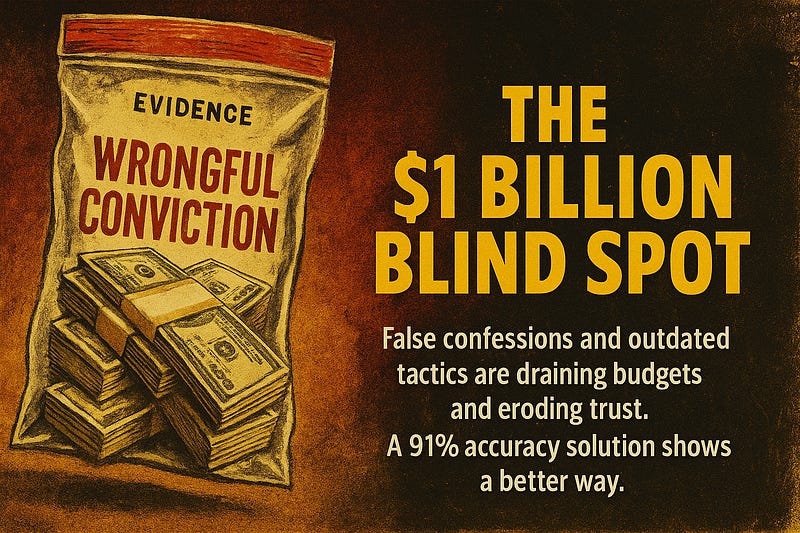
Police interrogations have a costly secret. Overconfident “lie-detection” training isn’t just inaccurate, it’s fueling false confessions, wrongful convictions, and huge legal payouts. New evidence-based methods, like AI-driven verbal analysis and the PEACE model, offer a 91%‑accuracy fix to save money, justice, and lives.
The Billion‑Dollar Blind Spot
Not-So Fun Fact: In 2024, the City of Chicago paid $50 million to four men coerced into false confessions.
Police departments across the country are paying a fortune for interrogation errors. False confessions and wrongful convictions have forced cities to settle for millions in damages. Why? Because too many detectives trust their gut over facts.
For decades, the research has reliably shown people are only 54% accurate at spotting lies, about as good as a coin flip. Yet traditional training still preaches that officers can “read” deception from body language and stress cues. This blind faith in outdated techniques isn’t just a quirk; it’s a deadly blind spot costing taxpayers and communities dearly.
Illinois, 2004. Kevin Fox was interrogated for 14 hours after his 3‑year-old daughter was murdered. With no lawyer present and under crushing pressure, he falsely confessed to a crime he didn’t commit. DNA evidence cleared him eight months later. A jury eventually awarded the Fox family $15.5 million in damages for the detectives’ misconduct (Fox v. Hayes, №08‑3736.)
Every dollar spent fixing these errors is a dollar not spent on real public safety. Beyond the payouts, the human cost is incalculable: innocent people in prison, real criminals left free, and community trust in shambles. It’s a self-inflicted wound. Since 1989, false confessions have caused over been found in thousands of wrongful convictions nationwide. Often, the victims are some of societies most vulnerable populations. These are the cases where people are fortunate enough to not have the criminal justice system entirely give up. More often, these are the cases where folks were so fortunate that evidence happened to be found later and exonerate them. This is so far from the norm. Even in cases without coerced confessions, we find current interrogation methods leading to entirely incorrect conclusions about guilt and justice.
This is the billion-dollar blind spot: a systemic training failure that flies under the radar and put innocent people in jail because of “gut instincts” and outdated methods.
Outdated interrogation tactics are a blind spot costing us trust, truth, and tax dollars.
Modern policing can do better. Forward-thinking agenciesare waking up to the data and demanding change. For others still unconvinced, consider this simple question: *What’s more expensive — preventing these errors, or paying for them afterward?
Training Budget Math**: Re-training an entire department in modern methods costs **a fraction** of one big wrongful-conviction settlement.
If our built-in “lie-radar” were a gadget, it would’ve been recalled by now. To see why, just look at how it performs under real test conditions. In controlled studies, even experienced officers struggle to separate truth from lies any more reliably than the average person. They often fall for cliché cues such as fidgeting, avoiding eye contact, sweaty palms. The fact is, decades of science has demonstrated these to be poor signals of deception. We train cops to spot a liar with tricks that don’t even beat chance. It’s wishful thinking, baked into the academy and culture of departments nationwide.
Case in point: the Reid technique, a 1960s-era accusatory interrogation method that still dominates U.S. police training. Reid-style teaching claims that behavioral cues, like gaze or posture, can reliably flag lies. But when researchers stress-tested that claim, it collapsed. In truth, innocent people under stress often exhibit the same nervous behaviors that guilty people do. Additionally, anyone with an ounce of humility knows just how effectively a practiced and manipulative liar can tell an untrue story while looking remarkably calm. Our lie-detection “radar” gets jammed by bias and noise. As multiple meta-analysis concluded, most people, cops included, can’t discern lies in real time any better than guessing
There are methods for improving deception detection accuracy, and we will get into that in a bit.
So why do these methods persist? Partly because of tradition and Hollywood myth, and partly because of overconfidence. But the results speak loudest. Junk science interrogation tactics have led to innumerable wrongful convictions. Particularly among disabled and other vulnerable populations. They also waste investigative resources chasing false leads. It’s time to retire the magic wand approach to lie detection and replace it with methods that are proven to actually work.
Payout Per Bad Interview: A single flawed interrogation can trigger over $15 million in settlement costs. That doesn’t include the human cost of the fact that every time the wrong person goes to jail, the real criminal gets to continue walking the streets.
When it comes to spotting deception, confidence can be a killer. The interrogator who is sure they can “see guilt” in a suspect’s face is exactly the one who shouldn’t be trusted without evidence. Studies show that when officers, and the general public, have extreme confidence in their lie-detection abilities, they often perform considerably worse than those with more moderate self-assessments. In one experiment, the self-described human lie detectors scored the lowest accuracy of all. Meanwhile, participants who admitted the task was hard tended to do much better. Overconfidence breeds tunnel vision: an officer convinced they’re right will disregard contradictory evidence or coercively press an innocent person to confess, certain they’ve “got the guy.”
This isn’t just theory, it’s happening in real cases. Overconfident interrogation styles contributed to high-profile false confessions from Chicago to New York. From the Central Park Five to countless smaller cases, investigators too sure of their instincts pushed innocent people until they “confessed.” Once that happens, confirmation bias kicks in and it’s game over for the truth. As one former detective put it, “If I know you’re lying, I’m not stopping until I hear what I want.” Such attitudes are a direct product of training that rewards confidence over accuracy.
As a former police officer, I can tell you firsthand: promotions and respect go to those who put people away, not necessarily those who get it right. Justice isn’t measured, only convictions. Ultimately, that’s not accountability, it’s careerism, and it’s why interrogation practices urgently need reform.
The paradox is clear: to improve accuracy, interrogators must doubt themselves with a scientific detachment and rely on evidence-based practices. Gather the facts and let the results show.
Confidence should come from proven technique, not gut feeling. Unfortunately, current police culture often equates admitting uncertainty with weakness. Changing that mindset is a top-down challenge, one chiefs and trainers can tackle by promoting humility as a professional strength. In interrogation rooms, a dose of healthy humility will save lives.
The 91 % Fix: Verbal Analytics + PEACE
Pilot Data ROI: In trials, pairing officers with AI language analysis boosted lie-detection accuracy by 23% (compared to officers alone).
Enough about the problem: what’s the solution?
Fortunately, we have one, and it’s already showed remarkable results. The answer lies in the combination of two powerful tools: evidence-based interviewing and AI-assisted verbal analytics. Think of it as replacing guesswork with science. In U.K. policing, for instance, the PEACE model (Planning and Preparation, Engage and Explain, Account, Closure, Evaluate) has been the gold standard for decades, emphasizing open-ended questions and rapport over accusatory tactics. PEACE-trained investigators focus on gathering information, not extracting confessions, which dramatically reduces false confession rates and bias.
On the tech side, algorithms can now analyze speech patterns and word choice far better than humans in real time. Linguistic tools like LIWC (Linguistic Inquiry and Word Count) flag subtle verbal cues that correlate with deception, things a human ear might miss.
In epistemologically rigorous field tests, an AI-driven text analysis system correctly identified truthful vs. deceptive statements with ~91% accuracy, crushing the human average. Even better, when human investigators used the tool’s feedback, for tools such as noticing inconsistencies the AI highlighted, their accuracy jumped significantly. It’s the best of both worlds: human judgment guided by objective analytics.
Crucially, these tools also level the playing field. A software algorithm doesn’t care about a suspect’s ethnicity or accent; it looks at the content of their speech. By focusing on verbal indicators, what is said and how it’s structured, rather than shaky behavioral myths, we not only boost accuracy but also fairness. Early pilots in law enforcement show promising ROI: fewer false leads, quicker clearance of innocent suspects, and more credible cases against the truly guilty. All that, often for less cost than a round of outdated “body-language” training seminars.
Here’s the best part: adopting the 91% fix is well within reach. The PEACE framework is public and has plenty of training materials available, though the best materials on the subject obviously come from this article’s author. AI analysis tools can integrate with something as simple as a body-cam or recorded interview audio. Some agencies have already quietly started using them to review interrogations in real time, acting like a coach in an earpiece. The initial concern, that AI might replace human detectives, has proven unfounded. Instead, AI is becoming the savvy sidekick that helps the detective shine. It’s time to bring these innovations to every interview room in America.
Action Timeline 90 days: In just 3 months, a department can retrain officers, update policies, and launch a pilot program in modern interrogation tactics.
Police chiefs and public safety leaders don’t have to wait for lawsuits or new laws to force their hand. There are many levers you can pull right now to start modernizing interrogations.
Updating policy for more effective and modernized policing isn’t complicated. It begins with issuing a directive replacing old-school interrogation such as the Reid technique with the PEACE model (or similar evidence-based methods). Next, it involves banning purposefully deceptive tactics in interviews today (40 states still allow police lies during questioning. This includes lying to disabled people, children and other vulnerable populations. Another crucial step is making video recording of all subject interrogations mandatory for accountability. These policy changes cost little or nothing, but pay off by preventing abuses that lead to pain suffering, death, and the revocation of innocent peoples freedom. For policy makers, this sends a clear message to the community: integrity and accuracy matter more than “closing” a case fast.
By leveraging these steps, any law enforcement leader can start closing the gap between antiquated practices and modern, proven techniques. The beauty of it? Each lever reinforces the others. Better training + smart tech + transparency is a recipe for fewer wrongful convictions, fewer multi-million-dollar settlements, and more justice for all.