
On Originalism: The Constitutional Grift and its Christian Cousin
What is true Originalism?

AUTHOR’S NOTE: Before the article, one thing you can do today. Epstein’s trafficking operation reached every state in the country and the entire federal government is actively covering it up. The Child Sex Trafficking Investigation Act is model state legislation designed to launch state-level investigations to see where the Epstein Files intersect with and violate state criminal law. It was written for North Carolina but it works anywhere; your representative just has to swap out the state name. Send it to your state representative and tell them to introduce it. You can find your rep and their contact information at openstates.org. Any state legislator who won’t publicly and enthusiastically push for this is complicit in the cover-up. Document every step publicly. Post screenshots when you send it. Post when they respond. Post when they don’t. You don’t have to share the whole article; just copy this note and encourage others to do the same.
The Declaration of Independence is one of the most frequently cited and least frequently read documents in American history. Everybody knows the words. The people who call themselves originalists don’t follow them to where they lead. The people who do follow them there, the ones who fight for universal healthcare and labor rights and equal protection, don’t realize they’re the originalists. They just think they’re progressives. The irony is that the people who actually arrive where the text leads don’t claim the label, and the people who claim the label never arrive where the text leads.
“We hold these truths to be self-evident, that all men are created equal, that they are endowed by their Creator with certain unalienable Rights, that among these are Life, Liberty and the pursuit of Happiness.”
Jefferson didn’t write “all citizens are created equal.” He didn’t write “all Americans.” He didn’t write “all men within the jurisdiction of the United States.” He wrote “all men are created equal” and then grounded their rights not in law, not in citizenship, not in geography, but in creation itself. “Endowed by their Creator.” These rights exist because you exist. You don’t earn them by being born on the right side of a border. You don’t lose them because someone declared war on your country. A kid in Gaza pulling bodies out of rubble has them. A man who’s been sitting in Guantanamo for 22 years without a trial has them. A family in Ohio watching ICE break down their door at 4 AM has them. The text doesn’t leave room for exceptions because the founders didn’t write any.
Jefferson owned slaves. The founders failed their own words from the moment they wrote them. Women couldn’t vote. Black people were property. Native Americans were slaughtered. Everybody knows that. But the words are still there, and the words are still right. The founders were Enlightenment thinkers writing forward, toward something, away from monarchy, away from divine right, away from the idea that power flows down from kings to the people beneath them. They didn’t write “we have formed a perfect union.” They wrote “a more perfect union.” The whole project was aspirational, a declaration of who we should become, and they built a framework designed to let future generations close the gap between the ideal and the reality.
We don’t need to update the founding principles. We just need to actually follow them. And the people who claim they’re following them most closely are the ones betraying them most completely, dragging us back toward the pre-Enlightenment concentration of power the founders fought a war to escape. One con, running on one group of people, through two institutions: the church and the court, the preacher and the judge, prosperity gospel and originalism. The same lie, selling the same marks a version of their own sacred text that conveniently serves the people doing the selling.
Jefferson’s swap of Locke’s language tells us more than most law school seminars. John Locke’s Second Treatise of Government, the political philosophy text that most of the founders treated as foundational, listed the core rights as “life, liberty, and property.” Jefferson picked up the pen and swapped “property” for “pursuit of happiness.” Carli Conklin at the University of Missouri traced what that phrase actually meant to people in the eighteenth century, and it had nothing to do with feeling good. It meant something closer to the Greek idea of eudaimonia, human flourishing, the ability to live a full life on your own terms. Jefferson took the foundational statement of human rights and deliberately removed private property from the top three.
Jefferson’s own letters make his thinking even harder to dodge. He wrote to Madison in 1785 that “the laws of property have been so far extended as to violate natural right” and that “the earth is given as a common stock for man to labor and live on.” He proposed taxing the wealthy “in geometrical progression as they rise” while exempting the poor entirely. In 1813 he wrote to Isaac McPherson that “no individual has, of natural right, a separate property in an acre of land” and called stable ownership “the gift of social law.” Jefferson put property rights on a lower tier than human rights. They’re useful, they’re necessary, but they’re a social invention, not a natural one. When property rights and human rights collide, the human rights are supposed to win. That’s the founder the originalists claim to follow, saying in his own handwriting that land ownership is a convenience we made up, not a sacred right we were born with. The Bible the originalists claim to follow says the same thing; in Matthew 25, Jesus makes the care of hungry, sick, and imprisoned people the sole criterion for salvation and never mentions property at all.
Take “life” seriously. If life is an unalienable right, and governments exist “to secure these rights,” which is what the Declaration says is the entire reason governments are created, then a government that lets people die of treatable illness when it has the means to save them fails the most basic obligation the founders laid out. That’s just what the text says when you follow it forward.
Take “liberty.” If liberty means freedom from coercion, it has to include the coercion of an employer who holds your healthcare hostage, who can fire you for organizing, who can work you into the ground because the alternative is losing everything. Adam Smith, the man the right treats as their patron saint, understood this perfectly. In “The Wealth of Nations,” published months before the Declaration, he wrote that a master can hold out for a year or two on what he’s already got, but “many workmen could not subsist a week, few could subsist a month, and scarce any a year without employment.” He said employers are “always and everywhere” in a tacit combination to keep wages down. And when workers tried to organize, the law came down on them, not the bosses: “We have no acts of parliament against combining to lower the price of work; but many against
combining to raise it.” Franklin met Smith in Scotland. They corresponded. The intellectual tradition the founders drew from screamed for labor protections.
And corporations. The word “corporation” appears nowhere in the Constitution. The word “person” in the Fourteenth Amendment referred to formerly enslaved human beings. Corporate constitutional rights trace back to an 1886 headnote written by a court reporter who was a former railroad company president in Santa Clara County v. Southern Pacific Railroad; the Court’s actual opinion never addressed corporate personhood, and Chief Justice Waite admitted they had deliberately “avoided meeting the constitutional question,” as documented in Thom Hartmann’s “Unequal Protection” and C. Peter Magrath’s biography of Waite. The text doesn’t give corporations rights. No court ever ruled that it does. It just got written into the margins and nobody challenged it until Citizens United in 2010, when Justice Kennedy, a so-called originalist, decided that corporate political spending was what our founders intended.
That’s what honest originalism produces. Universal human rights without geographic or citizenship limitations. A government that can’t let people die when it can save them. Labor protections grounded in the founders’ own intellectual tradition. The rights of corporations never supersede the rights of the people. And this reading has serious institutional support from across the spectrum. Jack Balkin at Yale showed in “Living Originalism” that modern civil rights and civil liberties are “fully consistent with the Constitution’s original meaning.” Randy Barnett, the libertarian the Federalist Society claims as their own, argued in “Restoring the Lost Constitution” that the Ninth Amendment creates a “presumption of liberty.” The Harvard Civil Rights-Civil Liberties Law Review concluded that “originalism arguably holds the greatest potential for expanding civil rights.” These are people who read the document and said what it says.
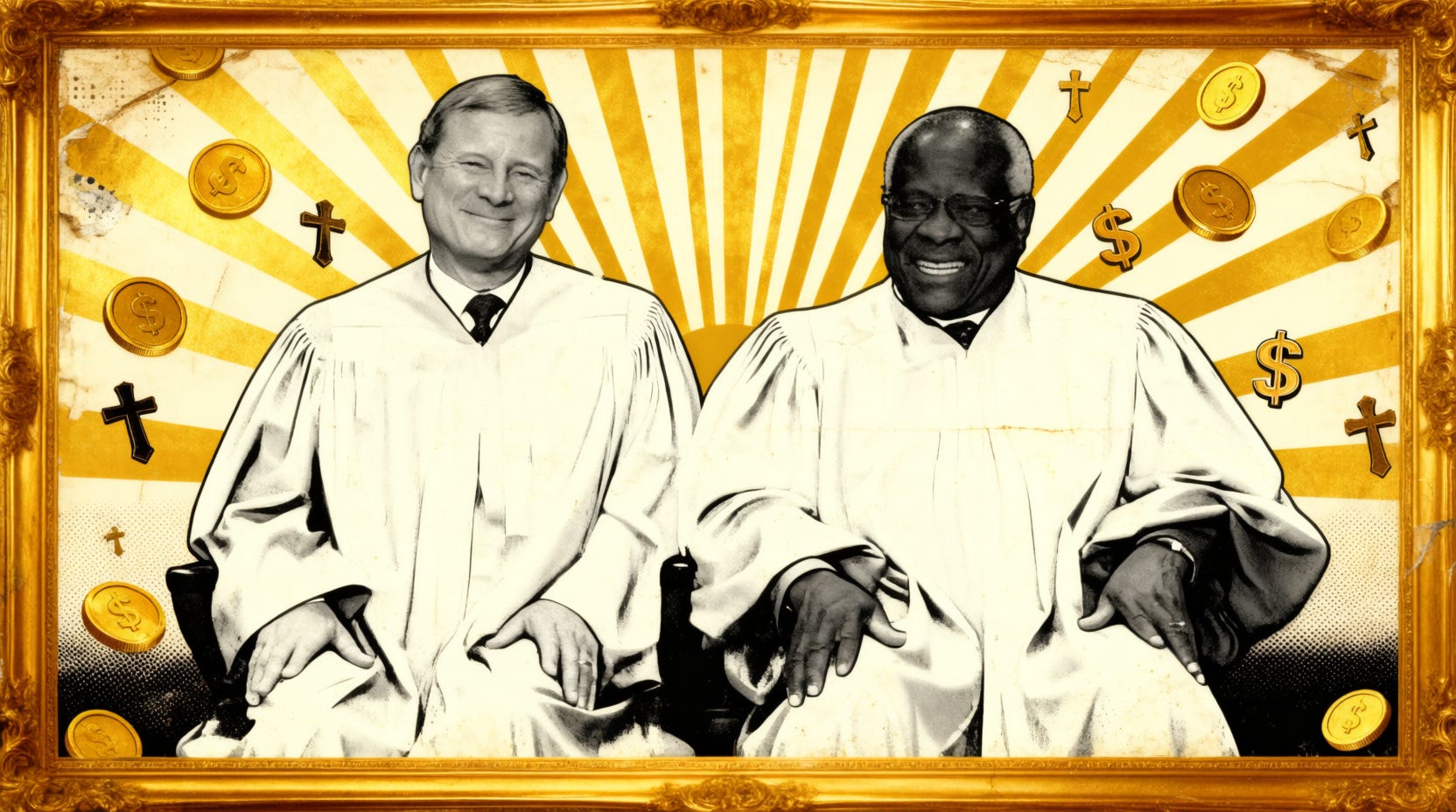
John Roberts has read the Constitution. Leonard Leo has read it. The Federalist Society guys went to law school; they can parse a sentence. They know what the text says. They lie about it for the same reason Joel Osteen lies about the Sermon on the Mount: the truth doesn’t pay. Steven Calabresi, one of the Federalist Society’s three founders,
admitted that when Ed Meese gave his landmark 1985 speech calling for “a Jurisprudence of Original Intention,” there was “not a single tenure-track member of any law school faculty anywhere in the United States publishing serious work developing an originalist theory,” as documented in Amanda Hollis-Brusky’s “Ideas with Consequences.” It didn’t exist as serious scholarship. It was built on purpose, with money. The John M. Olin Foundation alone poured $5.5 million into the Federalist Society and spent over $370 million total on the conservative legal project, as Steven Teles detailed in “The Rise of the Conservative Legal Movement,” including all-expenses-paid seminars for sitting federal judges that journalist Jane Mayer described in “Dark Money” as “a cross between Maoist cultural reeducation camps and Club Med.” By one count, 40 percent of the federal judiciary attended. Hollis-Brusky documented how the Society promoted theories that had previously been “dismissed as ludicrously radical” until its network of 40,000 members, five Supreme Court justices, and dozens of federal judges made those theories the law of the land.
Look at what they did to the document they claim to revere.
Qualified immunity. William Baude at the University of Chicago wrote the definitive originalist analysis and found that it “operates as an unwritten defense” to civil rights lawsuits, and that the statute it supposedly interprets “says nothing about any immunities, qualified or otherwise.” The Cato Institute called it “invented from whole cloth by the Supreme Court in open defiance of Congress.” Clarence Thomas himself said we should reconsider it in his concurrence in Ziglar v. Abbasi. Judge Don Willett, a Trump appointee on the Fifth Circuit, concurred dubitante in Zadeh v. Robinson and wrote that “qualified immunity smacks of unqualified impunity, letting public officials duck consequences for bad behavior, no matter how palpably unreasonable, as long as they were the first to behave badly.” When the Cato Institute and the ACLU agree, when Thomas and Sotomayor agree, that a doctrine has no textual foundation, an originalist has no business defending it.
The Ninth Amendment says the enumeration of certain rights “shall not be construed to
deny or disparage others retained by the people.” Madison wrote those words specifically to prevent the government from claiming that any right not on the list doesn’t exist, as he explained in his June 8, 1789 speech to the House of Representatives. Daniel Farber at Berkeley called it “an unexploded mine within the Bill of Rights” in his book “Retained by the People,” noting that it has never been the basis for a single Supreme Court decision. Robert Bork, the patron saint of conservative jurisprudence, dismissed it as an “inkblot” in his 1987 confirmation hearings before the Senate Judiciary Committee. A constitutional originalist calling one-tenth of the Bill of Rights an inkblot.
Presidential criminal immunity. This is the most brazen because there’s nothing to even twist. The doctrine appears nowhere in the text. David Adler at the Alturas Institute looked at the Court’s decision in Trump v. United States and pointed out that “an originalist method would begin with the text, but the Court doesn’t cite the text because there is no mention of immunity.” They didn’t cite the Convention debates either, because no delegate entertained the idea. The founders had just fought a war to escape a king. The idea that they then designed a presidency with royal legal protections would have appalled every person who signed the document.
The Fourth Amendment guarantees “the right of the people to be secure in their persons, houses, papers, and effects, against unreasonable searches and seizures.” Read those words, and then look at what the government does with them. Under Section 702 of the Foreign Intelligence Surveillance Act, the FBI ran more than 200,000 warrantless searches of Americans’ private communications in a single year, searching a database the NSA built by tapping into the infrastructure of American tech companies. The Foreign Intelligence Surveillance Court, which reviews these programs in secret proceedings where only the government shows up, issued opinions in 2018, 2019, 2020, and 2022 condemning the FBI’s “persistent and widespread” violations of even the minimal safeguards that exist, as the Brennan Center for Justice documented. Agents searched for information on journalists, political commentators, a sitting member of Congress, and members of a local political party. Meanwhile, civil asset forfeiture allows
police to seize cash, cars, and homes from people who have never been charged with a crime, let alone convicted of one. The Institute for Justice found that federal and state governments seized at least $68.8 billion in assets between 2000 and 2019; only 16 percent of federal forfeitures during that period involved a criminal conviction. In Philadelphia, a couple lost their home because their son sold $40 worth of drugs on the porch. A farmer carrying cash to an auction can have it confiscated at a traffic stop and then bear the burden of proving the money is innocent. The Fourth Amendment’s authors wrote “shall not be violated.” They didn’t add “unless a federal agency finds it inconvenient” or “unless a police department wants to pad its budget.”
The Emoluments Clause says no person holding federal office shall accept “any present, emolument, office, or title, of any kind whatever, from any King, Prince, or foreign State” without the consent of Congress. “Of any kind whatever.” For 230 years, every president observed this prohibition. Then Saudi lobbyists, bankrolled by the Saudi government, spent nearly $300,000 in three months at the Trump International Hotel alone. Zephyr Teachout at Fordham, one of the leading scholars on the clause, traced its origins to the founders’ “near obsession” with foreign corruption and argued that its reach was deliberately comprehensive, covering any profit or advantage flowing from a foreign state. Three separate lawsuits challenged the violations. The Supreme Court sat on the cases until the president left office, then dismissed them as moot. The constitutional prohibition just disappeared, not because anyone argued it doesn’t apply, but because no court would enforce it. And now, in a second term, the Trump Organization has revised its ethics policy to explicitly allow transactions with foreign governments and their intermediaries. The clause still says “of any kind whatever.” The words haven’t changed. The people sworn to uphold them just stopped reading.
The technique that makes all of this work is the same one that’s been running on another foundational text for centuries. Skip Leviticus 19 where God says to treat foreigners as native-born and love them as yourself. Skip Acts 2 where the early church held everything in common. Skip Matthew 19 where Jesus says a camel fits through a needle easier than a rich man enters heaven. Skip Luke 6 where he says woe to the rich.
Cherry-pick the tithing verses, rip them from context, build a theology that blesses wealth and power. Prosperity preachers cite 3 John 1:2, “I pray that you may enjoy good health and that all may go well with you,” as evidence God wants believers rich. That’s a letter greeting. Building theology on it is like building legal doctrine on “Dear Sir.”
The constitutional version works the same way. Cite the Second Amendment, ignore the Ninth. Cite original intent, ignore what the original intent actually was. The selection is the fraud.
And it works on the same people. Same congregation sitting in the same pew on Sunday hearing a liar tell them what the Bible says, then turning on the news Monday morning and hearing a liar tell them what the Constitution says. Erasmus identified the business model in 1509 in “In Praise of Folly”: the priests promote ignorance because “the people would part with less if they knew more.” Kierkegaard called it in 1855 in “Attack Upon Christendom”: “The Bible is very easy to understand. But we Christians are a bunch of scheming swindlers.” By the time the Federalist Society started selling originalism, the audience was ready-made. They’d already practiced not reading. One con, running on one group of people, through two institutions.
The Roberts Court legalized bribery in Snyder v. United States in 2024. A mayor steered $1.1 million in contracts to a company, then collected a $13,000 check afterward. The Court ruled 6-3 that payments after the fact aren’t bribes. Jackson’s dissent was blunt: “Greed makes governments, at every level, less responsive, less efficient, and less trustworthy.”
Then members of that same Court started collecting. ProPublica documented Thomas taking at least 38 luxury vacations, 26 private jet flights, trips on a 162-foot superyacht from Harlan Crow, whose company also bought property from Thomas’s family while his mother kept living there. Crow paid over $100,000 in private school tuition for Thomas’s grandnephew. Fix the Court put the total documented gifts from 2004 to 2023 at over $4.8 million. Thomas makes $285,000 a year. Alito took a fishing trip to Alaska
on Paul Singer’s private jet, worth over $100,000 if chartered, and then Singer’s hedge fund came before the Court in at least 10 cases. In one, the Court ruled 7-1 in Singer’s favor for $2.4 billion. Alito never recused.
The prosperity gospel preacher reads the Bible, knows what Jesus said about wealth, and lies about it because there’s more money in the lie. John Roberts reads the Constitution, knows what it says about public officials enriching themselves in office, and lies about it for the same reason. Then his Court makes the lying legal.
At some point the person in the pew stops being someone who got conned and becomes someone who chose the con because it felt good. When your pastor tells you God wants you rich and you don’t crack the book to check, maybe you were lied to. But when your faith becomes the excuse to strip rights from gay people, to cage children, to let the sick die because they can’t pay, that’s not gullibility anymore. That’s volunteering. The lie became a permission structure and you took the permission gladly.
Kierkegaard saw that too: “The apostasy from Christianity will not come about openly by everybody renouncing Christianity; no, but slyly, cunningly, by everybody assuming the name of being Christian.” The apostasy from the Constitution came the same way. Slyly, cunningly, with everyone calling themselves an originalist while doing the opposite of what the text demands.
Honest originalism produces a country where every human being has rights by virtue of existence. Where the government cannot let people die for lack of money. Where workers have the protections the founders’ own intellectual sources demanded. Where the rights of corporations never supersede the rights of the people. Where the president is not above the law because the founders never put him there. Where the full Bill of Rights, all ten amendments, actually means something. The people fighting for that country are the originalists, whether they use the word or not.
Just like it’s the duty of true Christians to actually read what Jesus said and live up to that ideal, it’s the duty of true Americans to actually fight to truly earn justice for all.
Democracy merch, Oppositional Federalism booklets at TheExistentialistRepublic.com
All educational materials available for free download in the shop at BuyMeACoffee.com/TheER
All citations are hyperlinked where referenced.
As was suggested in a recent court opinion, it seems some people take 1984 to be an instruction manual
Excellent article! I liked the way you tied it all together with documented examples.