

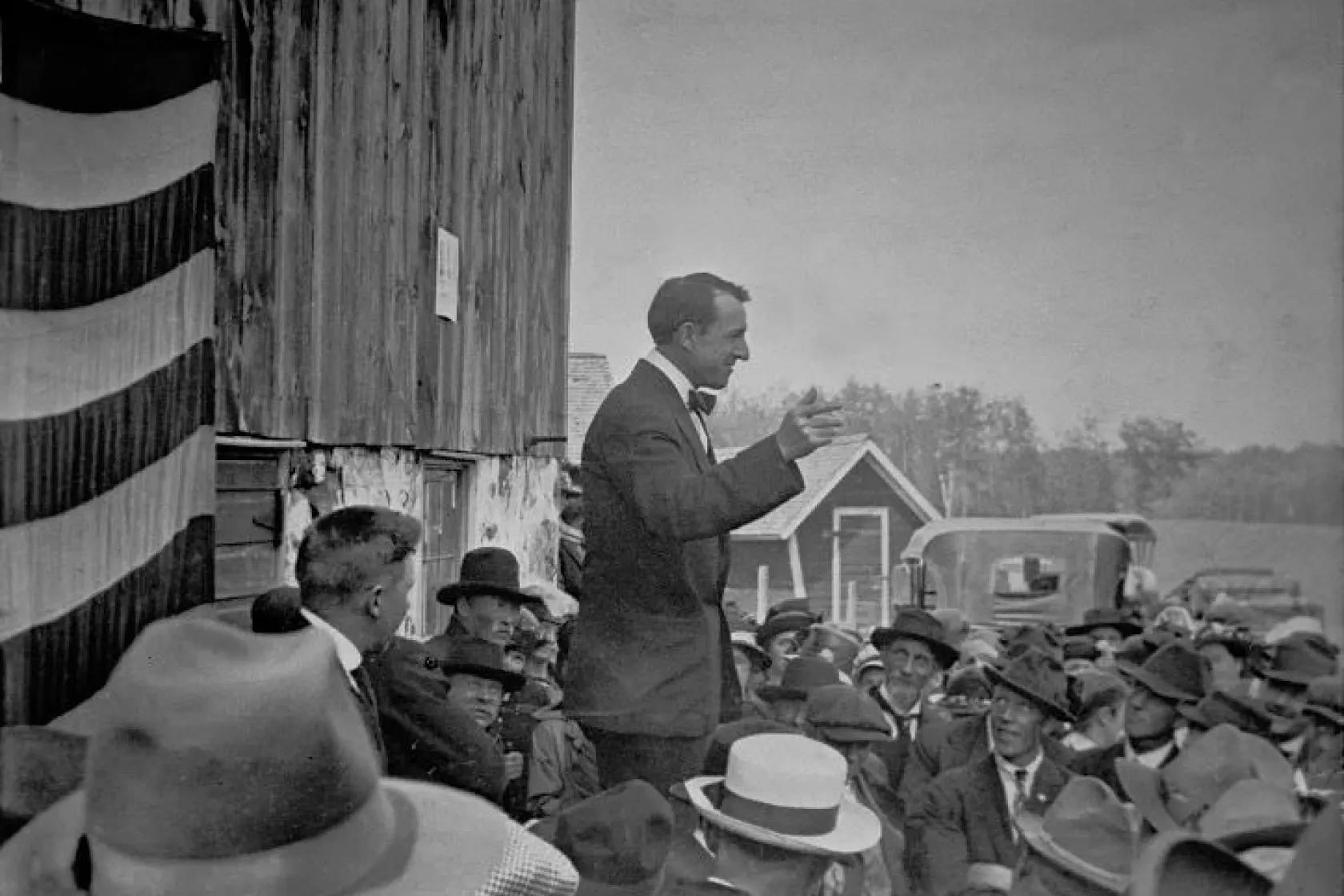
In 1915, a group of North Dakota wheat farmers went to the statehouse in Bismarck to ask their legislature for help. They wanted a state-owned terminal elevator so they could sell their grain without getting fleeced by out-of-state middlemen. A state representative named Treadwell Twitchell reportedly told the farmers crowding the balcony to “go home and slop the hogs.”¹
They did not go home. They built a political movement, won the governorship and both chambers of the legislature, and created a state-owned bank that has now operated continuously for over a century. They asked the only people whose permission mattered: the public. And then they built what they had promised. The bankers said it violated the state constitution and took it to the state Supreme Court. The farmers won. The history books say they won because the court found no constitutional violation, and that’s true, but a court that watched a political movement build a trifecta in three years, pass wildly popular legislation, and open a bank that was already generating revenue for the state had every reason to think carefully before telling those farmers to shut it down.
We’ve spent a decade defending democracy in courts, in state legislatures, in streets, and at ballot boxes. Here’s what we have to show for it. The administration fired more than 300,000 federal workers or drove them to resign rather than carry out orders they considered illegal or unethical, then imposed loyalty tests on everyone who remained.¹³ Seventy thousand people now sit in detention camps.¹⁴ Thousands of armed, masked federal agents operate in American cities without warrants, without oversight, and without accountability, because the GOP turned ICE into a jobs program for its most loyal and most violent followers and gave them carte blanche to cage, beat, and terrorize anyone who looks different or hurts their feelings.¹⁵ Anyone who thinks the midterms or a presidential election will fix this is giving way too much deference to a democracy that has been systematically disassembled over the last thirteen months.
And defense has a structural problem that no amount of effort can fix: someone else picks when and where to attack. We respond. They attack again. We respond again. They only need to break through once. We need to hold the line everywhere, forever.
North Dakota’s farmers figured this out in 1919. Stop defending. Start building. Launch a democracy offensive.
In the early 1900s, North Dakota was, as one historian described it, “a tributary province of Minneapolis-St. Paul.”² Minnesota banks controlled who got credit. Minnesota grain dealers controlled what farmers got paid for their wheat. The railroads controlled what it cost to ship that wheat to market. A North Dakota farmer could grow a good crop, bring it to the elevator, and watch someone from out of state set the price, skim the profit, and hand back whatever was left. Interest rates on farm loans ran as high as twelve percent.³ If a farmer wanted to complain, the political boss of North Dakota, Alexander McKenzie, lived in Saint Paul. The entire state existed to make money for people who didn’t live there.
A.C. Townley, a failed farmer turned political organizer, took the anger that Twitchell had so helpfully ignited and built something with it. He and a farmer named Frank Wood sat up late in a farmhouse near Deering, North Dakota, and scribbled a political platform on a scrap of wrapping paper by the light of a kerosene lamp.⁴ The platform called for state ownership of banks, grain elevators, and flour mills. Townley drove a borrowed Model T across the state signing up members at six dollars a head. The Nonpartisan League was born.
Within three years, the League controlled the governor’s office and both chambers of the legislature. In 1919, they built what they had promised: the Bank of North Dakota, a state-owned bank funded with two million dollars in initial capital, designed to make low-interest loans to farmers and serve as the depository for all state funds.³ They also created a state-owned grain elevator and a state hail insurance program. No feasibility study. No task force convened to determine whether a state-owned bank might theoretically survive judicial review. No blessing sought from the banking interests that controlled the state’s economy. They asked the voters, won the election, and built the bank. The entire platform, written on wrapping paper by lamplight, became law.
The legal challenge came from the outside. A consortium of Minneapolis banks, the same ones that had been profiting off North Dakota farmers for decades, organized a lawsuit and put forty-two North Dakota taxpayers’ names on it. Green v. Frazier argued that the bank violated both the state constitution and the Fourteenth Amendment of the United States Constitution.⁵ North Dakota fought it all the way to the Supreme Court, which affirmed the bank’s constitutionality in 1920.⁵
That bank has now operated continuously for over a century, turning a profit every single year since its founding. In 2024, it held $10.8 billion in assets, posted a net income of $200.4 million, returned $335 million to the state, and carried an S&P credit rating of A+/Stable.⁶ It partners with local banks across the state and administers over $1.1 billion in lending programs for school construction, infrastructure, water projects, and disaster recovery, all without competing with the private banks it was designed to support.⁶ It survived the Great Depression. It survived the farm crisis of the 1980s. It survived the 2008 financial collapse that brought private banks to their knees. It survived because it was built on something real: the needs of actual people, served by an institution that belonged to them.
That’s what offense looks like. You build the thing. You let it start working. It becomes part of people’s lives. And then you fight for it, because fighting for something real beats defending a hypothetical every time.
Now let us talk about Washington state, where good people have been fighting the right fight with the wrong playbook.
Senator Bob Hasegawa, a former Teamster truck driver from Seattle’s Beacon Hill neighborhood, first introduced a public banking bill in 2010 when he was still serving in the state House of Representatives.⁷ He watched Wall Street crash the economy in 2008 and has spent fifteen years trying to build something that would give Washington financial independence from the same banks that caused it. He has introduced or championed public banking legislation in nearly every session since, building coalitions, commissioning business plans, modifying the proposal to address every objection raised in committee. The latest vehicle, Senate Bill 5754, passed the Senate Business, Financial Services and Trade Committee in February 2025 with a 5-1 vote, then stalled in Ways and Means.⁸ The farthest any public banking bill has traveled in Washington was SB 5188, which passed the full Senate in 2018 and died in the House.⁹
Fifteen years of work by serious people who showed up, session after session. That persistence built something real: a legislative record, a coalition, a body of research, and a bill that’s come closer to passing with each attempt. The foundation is there. What needs to change is the strategy for building on it. Because embedded in that fifteen-year process is a pattern worth noticing: every session, the banking lobby kills the bill in committee, and every session the reason changes. First the legal structure wasn’t right. Then the business plan wasn’t finished. Then the fiscal model needed more study. The bill started as a state bank, became a “Washington Investment Trust,” evolved into a “public financial cooperative,” and returned to a state bank with a narrower scope.⁷ Each revision answered the objection that killed the last version. And each time, a new objection appeared, because the real obstacle was never the bill’s design. The real obstacle was bank money. In 2025, the excuse was a multibillion-dollar budget deficit that killed dozens of bills with fiscal impact. But the pattern predates the deficit by a decade, and the deficit will pass. The corporate money, the donor class, and the middlemen who profit off being needless gatekeepers while fleecing consumers without consequence are all permanent fixtures of the landscape. They were here before the deficit and they’ll be here after it.
Ask people who know Washington politics and most will tell you the constitution doesn’t allow it. No court has ever said that. But the banking lobby repeated it enough times that it became the thing everyone knows and nobody checks. You’d be surprised how much of politics works that way.
The constitutional terrain in both states is remarkably similar. North Dakota’s constitution, Article X, Section 18, says: “The state, any county or city may make internal improvements and may engage in any industry, enterprise or business, not prohibited by article XX of the constitution, but neither the state nor any political subdivision thereof shall otherwise loan or give its credit or make donations to or in aid of any individual, association or corporation except for reasonable support of the poor.”¹⁰
Washington’s constitution has Article VIII, Section 5: “The credit of the state shall not, in any manner be given or loaned to, or in aid of, any individual, association, company or corporation.”¹¹ And Article XII, Section 9: “The state shall not in any manner loan its credit, nor shall it subscribe to, or be interested in the stock of any company, association or corporation.”¹²
Both constitutions contain the standard prohibition against states loaning their credit to private entities. The difference is one sentence. North Dakota’s constitution includes an affirmative grant: the state “may engage in any industry, enterprise or business.” Washington’s doesn’t. That’s the gap. One sentence is the distance between a hundred-year-old bank with $10.8 billion in assets and fifteen years of failed legislation.
Or so the conventional wisdom holds. But read Washington’s constitution again. It prohibits the state from loaning its credit to private entities. A state-owned bank that serves as a public depository and partners with local financial institutions isn’t a loan of credit to a private entity. The state would be conducting its own business, managing its own deposits, and reinvesting its own revenue in its own people. Nothing in Washington’s constitution explicitly prohibits that, and why would it? It serves the public interest, and the Bank of North Dakota’s hundred-year track record proves it works. That’s a gap, not a wall.
So why has Washington spent fifteen years treating it like one?
Because the banking lobby shows up every session with reports, fiscal analyses, and constitutional memos. The public doesn’t exactly leave phones ringing off the hook over public banking. So the only detailed case most legislators hear is the case against, and it sounds reasonable, because it’s designed to. Good-faith representatives hear constitutional concerns from well-educated, persuasive people who are often well connected with donors and great at making friends, and it sounds like law. They vote no thinking they’re being responsible. The advocates, being serious people who believe in the process, take the legal objection at face value and redesign the bill to answer it. Next session, the lobby finds a new objection. The bill gets redesigned again. Fifteen years of this.
The obstacle was never the law. It was corporate money operating inside a Democratic trifecta, and the legislators repeating the lobby’s talking points aren’t being cynical. They’re being managed by an industry that knows exactly how to sound like the reasonable voice in the room. If you want to know what controlled opposition looks like, it doesn’t look like a legislator taking an envelope. It looks like a high-dollar donor saying “our state constitution doesn’t allow it” and a state representative saying “darn” and moving on.
The Democratic Party sits at 29 percent favorability. Less than half of Democratic voters approve of their own party’s performance in Congress, while 77 percent of Republicans approve of theirs.¹⁷ Republicans pass the bill and fight it out in court. Their voters love them for it. Democrats tell their voters the courts won’t allow it and ask for another session to study the problem. Their donor class and the corporations behind it keep handing them legitimate-sounding reasons to step in the way, and there’s always a reason not to do something if you really want to find one. Especially when you can throw out any number of hypothetical interpretations of laws that have never seen a day in court, or conjure infinite objections that aren’t wrong but sure as hell aren’t right either. Some of these representatives are friends of mine and I like them, but check yourselves, gang. Bob Hasegawa has been doing the right thing for fifteen years in a state where his party controls everything, and they still won’t let him build the bank. That doesn’t have to stay the case. We back the Hasegawas. We elect more of them. We don’t need lambs. We need lions.
North Dakota’s farmers never played that game. They didn’t try to win the bankers over. They went around them, built the bank, and let the bankers sue. Washington doesn’t need another redesign to satisfy another objection that will be replaced by a different objection next year. Washington needs to build the bank, and the bank is only the beginning.
Here’s what the full democracy offensive looks like.
Every state in the country already negotiates health coverage for its employees. Most of them hand that job to private insurers who skim administrative costs off the top, pay their executives bonuses with public dollars, and call it efficiency. CalPERS, the largest public employee benefits system in the country, still routes California’s tax money through corporate middlemen with higher overhead than a public operation would carry. That’s the gap. A state can build its own insurance pool, cut out the private carriers, negotiate directly with providers and hospitals, and open the pool to the public on a voluntary basis. Someone paying eight hundred dollars a month on the individual market for a plan with a six-thousand-dollar deductible gets access to the same coverage state employees have, at the same rates, through the same provider networks. The constitutional logic mirrors the bank: the state conducting its own business, managing its own risk pool, serving its own people. Once a million families are enrolled, the fight changes. Not because Republicans or the courts suddenly develop a conscience about hurting people, but because politicians who built the thing can look their constituents in the eye and say they delivered something real. They fought for it. They didn’t ask permission or wait for a committee to study it for another decade. That’s what voters want to see: their representatives taking ground, not giving it up. We need politicians who keep pushing the envelope until the Supreme Court’s docket is so full the justices have to choose between doing their jobs and vacationing with oligarchs. Build it, let it become part of people’s lives, and fight like hell to keep it.
Federal prosecutors confirmed that Jeffrey Epstein’s sex trafficking operation harmed more than 1,000 victims.¹⁸ Internal DOJ emails from 2019 show investigators discussing ten co-conspirators, and a 2020 email references a seven-page memo on “co-conspirators we could potentially charge” alongside an 86-page co-conspirator update.¹⁹ Of all those people, only Ghislaine Maxwell was ever charged. In July 2025, the DOJ released a two-page memo declaring it “did not uncover evidence that could predicate an investigation against uncharged third parties” and that no further disclosure would be “appropriate or warranted.”¹⁸ The president himself was a known associate of Epstein; he told New York Magazine in 2002 that Epstein was “a terrific guy” who “likes beautiful women as much as I do, and many of them are on the younger side,”²⁰ and flight logs released under the Epstein Files Transparency Act showed he traveled on Epstein’s plane more times than previously known.¹⁹ The federal government has every reason to make this disappear. A state attorney general doesn’t share those reasons. Sex trafficking, sexual exploitation of minors, and conspiracy are crimes in every state. If any of the conduct documented in those files occurred within a state’s jurisdiction, or if any of the people implicated reside in that state, the attorney general has every legal basis to open an investigation. Dual sovereignty means a state criminal prosecution operates independently of the federal system. The president can’t pardon a state conviction. The attorney general doesn’t answer to the White House. A state can launch an investigative task force, pursue criminal prosecution where the evidence warrants it, and enact financial penalties that pay for the investigation and provide restitution to victims. Some attorneys general could start tomorrow without waiting for a single new law. When a governor looks the public in the eye and says “the federal government won’t investigate the most powerful sex trafficking ring in American history, so we are,” and when a state attorney general announces charges against federal agents and administration officials who obstructed that investigation, the conversation about accountability stops being hypothetical. It becomes real. And real is what scares the people who depend on nobody ever looking.
Right now, a defense company’s executives max out their individual contributions to favored candidates. The company’s PAC writes six-figure checks to super PACs. The company funds trade associations that spend millions on “issue ads” running in the districts of appropriations committee members. A 501(c)(4) that doesn’t disclose its donors runs a parallel campaign. None of it technically coordinated with any candidate, because the law defines coordination so narrowly that everyone involved can keep a straight face. Then the contract gets awarded. The taxpayer pays. The person on the other side of that transaction is a small contractor who doesn’t have a PAC, doesn’t fund a trade association, can’t afford a lobbying operation, and keeps losing bids to the company that can. That person subsidizes their own exclusion every time they pay taxes. A state can end that. Not by restricting anyone’s speech; individual executives keep every First Amendment right to contribute their own money to whatever candidate or cause they choose. But the corporation’s money is a different question. A state that says “if your corporate treasury funds PACs, trade associations, or dark money groups that spend on political campaigns, you don’t get state contracts, state grants, or state tax incentives” isn’t punishing speech. It’s setting the terms for who gets public dollars, something states already do every time they write a procurement rule. Pick one: political influence or public money. Not both.
The most powerful nation on Earth is being run by people who treat the law as an obstacle to route around rather than a constraint to respect. A transnational network of oligarchs and opportunists has captured the federal government and is using it to extract wealth, punish dissent, and consolidate power. The teachers losing funding, the patients losing healthcare, the workers losing protections, the communities losing clean air and water can’t afford to wait for the next election cycle while we run another bill through another committee.
And if anyone believes the system will self-correct, consider who we're dealing with: a president who incited an insurrection, avoided prison, and pardoned roughly 1,500 of the people who stormed the Capitol.²¹ His party controls 23 state governments outright and is rewriting the election laws in every one of them.¹⁶ They've packed the courts that will hear challenges and gutted the institutional safeguards that once made correction possible. If you believe these people won't break any law necessary to retain power, I have a bridge to sell you.
In every blue state in this country, we can build what those North Dakota farmers built: institutions that serve real people and belong to them. Public banks that keep state revenue circulating in state economies. Health insurance pools that let a million families see a doctor. State attorneys general who investigate the criminal conspiracies the federal government is covering up. Procurement rules that refuse to let corporate money buy its way to the public till. We can build all of this within existing legal frameworks, and where those frameworks are ambiguous, we do what North Dakota did: build first, fight later.
If the courts tell us to stop, we'll hear them out. And then we'll weigh what they say against what we owe the people who depend on what we built, against a hundred years of proof that it works, against the track record of a judiciary that granted a president absolute immunity and looked the other way while its own members accepted undisclosed gifts from billionaires with pending cases. The farmers who built the Bank of North Dakota didn't ask a court for permission. They decided their people needed a bank more than the grain dealers of Minneapolis needed another season of skimming the profits off someone else's harvest. They built it. The courts caught up.
In 1915, a man in a statehouse told a group of farmers to go home and slop the hogs. They did not go home. They built a bank that has outlived every governor, every legislature, every legal challenge, and every political movement that ever tried to kill it. A hundred and six years later, it holds ten billion dollars and it still belongs to the people of North Dakota.
The model works. It has worked for a hundred and six years. We're long overdue to build the next one.
Go to TheExistentialistRepublic.com for pro-democracy merch, Soft Secession intro booklet, and my newest book “Toppling Tyrants: A Field Guide to Dismantling American Fascism”
Find free digital version of model legislation, my books, booklets, pamphlets in the store at BuyMeACoffee.com/TheER
References
¹ Coleman, P. K., & Lamb, C. R. (Compilers). (1985). The Nonpartisan League, 1915-1922: An annotated bibliography. Minnesota Historical Society Press; see also The BND Story. (n.d.). The birth of the Nonpartisan League. https://thebndstory.nd.gov/the-early-years/the-nonpartisan-league/
² Nonpartisan League. (n.d.). Encyclopedia of the Great Plains. University of Nebraska-Lincoln. https://plainshumanities.unl.edu/encyclopedia/doc/egp.pd.039.html
³ Bank of North Dakota. (2017). BND operations. https://bnd.nd.gov/about-bnd/bnd-operations/
⁴ The BND Story. (n.d.). The birth of the Nonpartisan League. North Dakota State Government. https://thebndstory.nd.gov/the-early-years/the-nonpartisan-league/
⁵ Green v. Frazier, 253 U.S. 233 (1920).
⁶ Bank of North Dakota. (2025, May 22). Bank of North Dakota releases 2024 annual report. https://bnd.nd.gov/bank-of-north-dakota-releases-2024-annual-report/
⁷ Public Banking Institute. (2018). Persistence wins in Washington State as legislators are just three votes away. https://www.publicbankinginstitute.org/persistence_wins_in_washington_state_as_legislators_are_just_three_votes_away; see also Hasegawa, B. (2025, February 14). Public testimony, public banking. Washington Senate Democrats. https://senatedemocrats.wa.gov/hasegawa/2025/02/14/public-testimony-public-banking/
⁸ Washington State Legislature. (2025). SB 5754: Creating the Washington state public bank. https://app.leg.wa.gov/billsummary/?BillNumber=5754&Year=2025
⁹ Rossi, M. R. (2025, March 7). Public banking advocates look ahead to 2026 after Senate opts not to advance bill. NPI's Cascadia Advocate.
¹⁰ N.D. Const. art. X, § 18.
¹¹ Wash. Const. art. VIII, § 5.
¹² Wash. Const. art. XII, § 9.
¹³ Kupor, S. (2025, November 26). Office of Personnel Management workforce update. As reported in Federal News Network. https://federalnewsnetwork.com/workforce/2025/11/317000-feds-have-left-the-government-this-year-surpassing-opms-goal/; see also Shapiro, A. (2025, December 18). Mass firings, buyouts and heightened uncertainty led to an exodus of federal workers in 2025. NPR. https://www.npr.org/2025/12/18/nx-s1-5626822/trump-federal-workers-firing-civil-servants
¹⁴ American Immigration Council. (2026, February). New report details ICE's expanding and increasingly unaccountable detention system. https://www.americanimmigrationcouncil.org/blog/ice-expanding-detention-system/
¹⁵ City of Minneapolis. (2026, January). MN Attorney General, Minneapolis and Saint Paul sue to halt ICE surge into Minnesota. https://www.minneapolismn.gov/news/2026/january/ag-lawsuit/; see also Operation Metro Surge. (2026, February 15). In Encyclopaedia Britannica. https://www.britannica.com/event/2025-26-Minnesota-ICE-Deployment
¹⁶ State government trifectas. (2026, February 17). Ballotpedia. https://ballotpedia.org/State_government_trifectas; see also Election results, 2025: State government trifectas. Ballotpedia. https://ballotpedia.org/Election_results,_2025:_State_government_trifectas
¹⁷ Quinnipiac University Poll. (2025, December 17). Voters give Democrats in Congress a record low job approval. https://poll.qu.edu/poll-release?releaseid=3943; see also Economist/YouGov Poll. (2026, January 23-26). Opinion of congressional Democrats plunges thanks to flagging support within their own party. YouGov. https://today.yougov.com/politics/articles/53956-opinion-of-congressional-democrats-plunges-flagging-support-within-democratic-party-january-23-26-2026-economist-yougov-poll
¹⁸ U.S. Department of Justice & Federal Bureau of Investigation. (2025, July 7). Memorandum re: Exhaustive review of investigative holdings relating to Jeffrey Epstein. As reported in Lucas, R. (2025, July 7). DOJ says no evidence Jeffrey Epstein had a "client list" or blackmailed associates. NPR. https://www.npr.org/2025/07/07/g-s1-76367/doj-jeffrey-epstein-memo
¹⁹ DOJ releases huge set of Epstein files with many mentions of Trump, says more documents to come. (2025, December 23). CBS News. https://www.cbsnews.com/live-updates/epstein-files-released-documents-2025/; see also U.S. Department of Justice, Office of Public Affairs. (2026, January 30). Department of Justice publishes 3.5 million responsive pages in compliance with the Epstein Files Transparency Act. https://www.justice.gov/opa/pr/department-justice-publishes-35-million-responsive-pages-compliance-epstein-files
²⁰ Thomas, L., Jr. (2002, October 28). Jeffrey Epstein: International moneyman of mystery. New York Magazine. https://nymag.com/nymetro/news/people/n_7912/
²¹ Bauder, D., Kunzelman, M., & Tucker, E. (2025, January 21). Trump gave pardons to hundreds of violent Jan. 6 rioters. Here's what they did. NPR. https://www.npr.org/2025/01/21/nx-s1-5268919/trump-issues-jan-6-pardons-attack-capitol-clemency
The oligarchs and superpacs are at the root of so much that is wrong with the country. Efforts to reign in the super-rich are essential to return to our republican democracy roots.
I think you need to run for office. Your ideas are exactly what’s needed now but who is taking that ball and running with it?? Thank you for continuing to point the way!