
Did Clarence Thomas Commit a Crime That Could Get Him 5 Years in a Virginia State Penitentiary?
The answer probably won't surprise you.

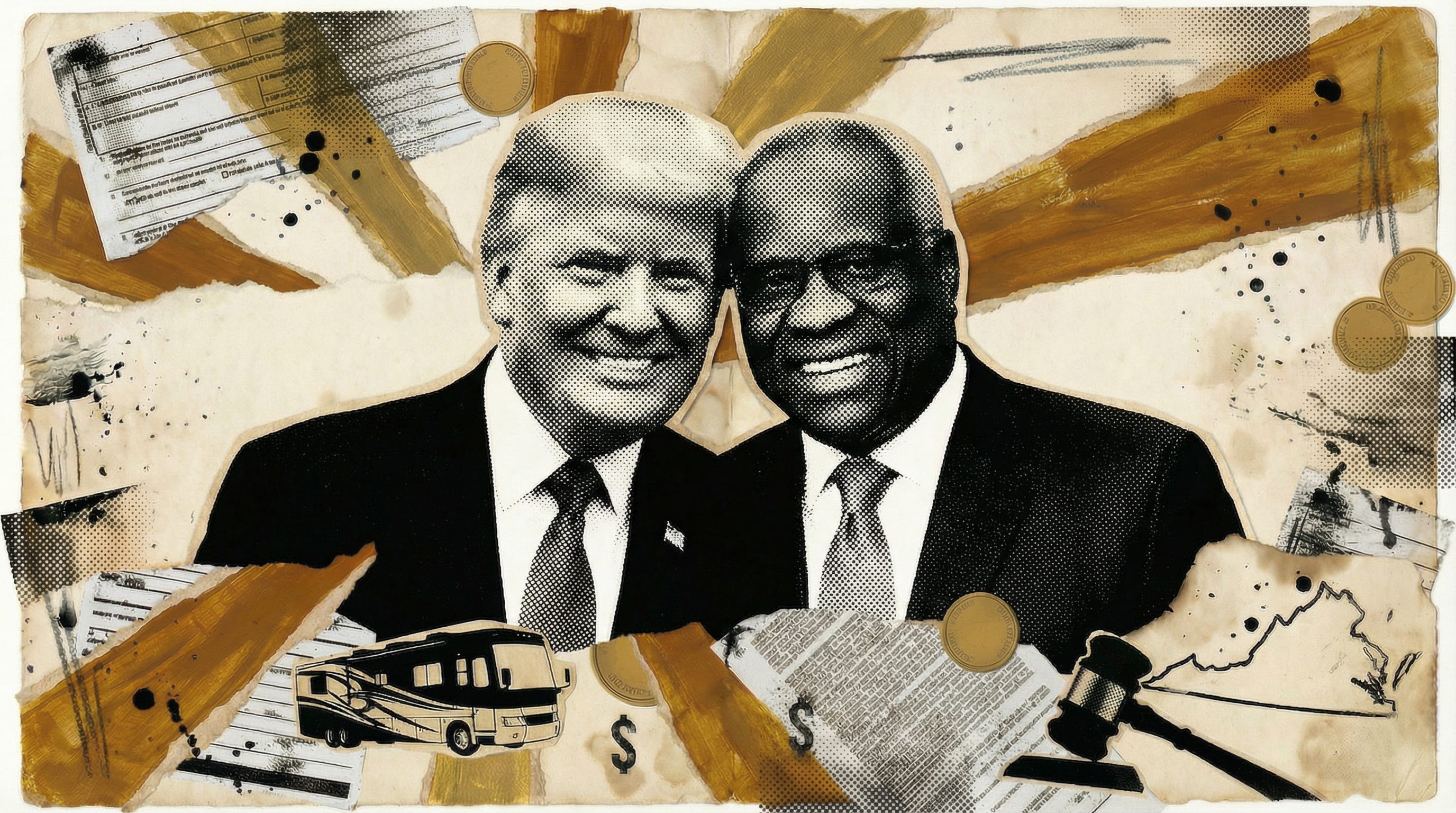
Virginia Code Section 58.1-348 makes it a Class 6 felony to file a false individual income tax return with intent to defraud the Commonwealth, punishable by one to five years in a state correctional facility, or in the jury’s discretion a jail term of up to twelve months and a fine of up to $2,500.¹ The publicly available evidence suggests Clarence Thomas committed that crime. Who knows what supporting evidence an investigation would discover. Let us walk through what we know.
For that charge to hold, a prosecutor must establish three conditions. Thomas must file a Virginia income tax return. His return must contain a false statement. And he must have made that false statement with intent to defraud the Commonwealth out of tax revenue. We are going to walk through each of those conditions and show, using publicly available evidence, that all three hold. Then we will tell you exactly where to refer this case and who has the authority to file it.
Thomas’s address satisfies the first condition. He lives in Fairfax Station, Virginia, and he files Virginia returns. The second depends on whether he received taxable income he failed to report. Between 2004 and 2023, he accepted confirmed and likely gifts worth an estimated $4.2 million from a small group of billionaires, each of whom appears to have entered his life only after he joined the Supreme Court in 1991. Fix the Court, a judicial reform group, documented the total.³ Harlan Crow, a Dallas real estate magnate and Republican megadonor, provided the bulk: superyacht cruises through Indonesia, private jet flights on his Bombardier Global 5000, annual stays at his private Adirondack resort, trips to the Bohemian Grove in California. ProPublica reported that a single trip to Indonesia in 2019 would have cost more than half a million dollars to replicate commercially.⁴ David Sokol, the former Berkshire Hathaway executive, provided luxury suite access at football games. H. Wayne Huizenga, the Blockbuster and Waste Management magnate, sent his personal Boeing 737 to pick Thomas up and fly him to South Florida. ProPublica documented all of this in its reporting on Thomas’s other billionaire benefactors.⁵ Paul “Tony” Novelly, an oil billionaire, provided additional undisclosed travel.
Fix the Court calculated that the total value of undisclosed gifts Thomas accepted came to nearly ten times the combined gifts received by every other sitting Justice during the same period, a finding the Senate Judiciary Committee cited in its December 2024 report.⁶
Those gifts connect to a false tax return through one provision of Virginia’s tax code. Virginia charges income tax based on whatever you reported to the IRS as your income. The Commonwealth’s tax code starts from Federal Adjusted Gross Income, the number on your federal Form 1040, and builds Virginia taxable income from there.⁷ If you understated your income on your federal return, you automatically understated it on your Virginia return. Every dollar Thomas excluded from his federal taxes flowed through as a false number on his Virginia filing.
No one outside the IRS has seen Thomas’s actual tax returns. But a man who concealed these benefits from every disclosure form that required them, who amended those forms only after journalists published what he had hidden, did not walk into his accountant’s office and volunteer them as income. The inference runs one direction.
Whether those dollars count as taxable income depends on how Thomas received them. Some of those transfers have hard numbers attached that do not require any legal interpretation at all, and the clearest example is the Savannah real estate deal.
In October 2014, one of Crow’s companies paid $133,363 for three properties in Savannah, Georgia: Thomas’s mother’s home and two vacant lots, owned by Thomas, his mother, and his late brother’s family. ProPublica reported that Thomas had valued his one-third stake in these properties at $15,000 or less on financial disclosures.⁸ A year earlier, Crow paid $40,000 for a vacant lot and a small house on the same street.⁸ He paid the Thomas family more than three times what he paid for comparable properties on the same block. After the purchase, Crow’s company poured tens of thousands of dollars into renovations on the home where Thomas’s 87-year-old mother continued to live, rent-free, and took over her annual property tax payments.⁸
Thomas never disclosed the sale, despite a federal law requiring justices to report real estate transactions exceeding $1,000. He left the buyer’s identity blank on the form. Four ethics experts told ProPublica this appeared to violate the law.⁸
When a buyer pays three times what comparable properties sold for, the gap between market value and purchase price is income. A prosecutor does not need to resolve any doctrinal question to charge this. The premium above fair market value generates tax liability regardless of whether we call it a gift, compensation, or anything else. If Thomas excluded it from his federal return, it carried through as a false number on his Virginia return.
The broader pattern of billionaire gifts raises a second, independent basis for the charge. Whether those gifts count as taxable income depends on a legal test the Supreme Court itself created. In Commissioner v. Duberstein, the Court ruled that a transfer only qualifies as a tax-free gift if it comes from “detached and disinterested generosity.”⁹ When you apply that test to highly politically active billionaires who showed up in a Supreme Court Justice’s life after his appointment, who had financial and ideological interests before the Court, and who sustained a pattern of giving worth millions over decades, the transfers start looking a lot less like generosity and a lot more like income Thomas never reported. It mostly looks like bribes, but the Supreme Court has ruled that those are legal, so we can table that conversation.
Yale Law Professor George Priest, who vacationed with both Crow and Thomas, acknowledged that Crow viewed Thomas as having a “limited salary” and provided benefits to him accordingly. ProPublica reported on Crow’s yacht tax deductions in detail.¹⁰ Georgetown tax professor Brian Galle put it plainly: if people offer goodies to a Justice so he will stay in his role, that sounds like taxable income. The Lever investigated the tax implications of these transfers.¹¹ Some of the payments, including tuition for Thomas’s grandnephew at a private boarding school, went through Crow Holdings LLC, Crow’s business entity, not from Crow personally. ProPublica reported on the tuition payments in May 2023.¹² Tax experts flagged this immediately, because when a business entity makes a payment, it often takes a deduction. And a transfer that the giver deducted as a business expense is exactly the kind of thing the Supreme Court identified in Duberstein as failing the gift test. The Court ruled the Cadillac in that case taxable income partly because the company that gave it wrote it off.⁹
ProPublica’s IRS data showed Crow’s yacht company reported losses totaling approximately $8 million from 2003 to 2015, approximately half of which flowed to Crow personally as deductions to offset other income, with the remainder going to family co-owners.¹⁰ Having a Supreme Court Justice aboard helped characterize the yacht as serving business purposes, generating tax advantages. When the person giving you things gets a tax benefit from giving you things, the “detached and disinterested generosity” argument gets very hard to make. It’s being claimed as a business expense by one party and irrelevant to employment by the other.
So those are the two paths to a charge. The real estate premium above market value constitutes unreported income independent of any gift analysis. And the broader pattern of billionaire transfers fails the Duberstein test and constitutes unreported income on that separate basis. Both flow through to Virginia because Virginia starts from Federal Adjusted Gross Income.⁷ A false federal number means a false Virginia number. Thomas files Virginia returns, and his returns contain false statements because he excluded taxable income. That covers conditions one and two.
Condition three is intent. A prosecutor has to prove Thomas filed those returns knowing they contained false statements. That is the hardest element to prove; does the existing evidence meet that standard?
In 1997, Thomas disclosed a private jet flight from Crow on his financial disclosure form. He then stopped disclosing such trips for more than twenty years, despite accepting them virtually every year. ProPublica detailed the disclosure history in its original reporting.¹³ He knew these benefits required reporting. He reported one. Then he stopped. For two decades. Seven ethics law experts told ProPublica the law clearly required disclosure, and six other federal judges disclosed similar gifts during the same period, demonstrating that the judiciary widely understood the requirement.¹³
After ProPublica published its reporting in April 2023, Thomas amended multiple years of financial disclosures to include previously undisclosed gifts. His attorney, Elliot Berke, said there had been “no willful ethics transgression” and that “prior reporting errors were strictly inadvertent.” ProPublica reported on the amendments in August 2023.¹⁴ Thomas’s defense has gestured at the argument that he received informal advice suggesting personal hospitality from friends fell outside reporting requirements. Seven ethics experts told ProPublica that advice was wrong, and six other sitting federal judges disclosed comparable gifts during the same period, demonstrating that the judiciary broadly understood the obligation. An honestly-held-if-mistaken belief about reporting requirements can sometimes negate criminal intent, but it is harder to sustain when you reported the same category of benefit in 1997, stopped for two decades, and resumed only when journalists published what you had hidden. But the amendments kept coming, each one revealing something new that Thomas had not previously admitted. Of course, Thomas disclosed only what journalists had already found. The Senate Judiciary Committee’s report concluded that Thomas “chose to ignore legal obligations to disclose lavish gifts after media scrutiny over his disclosures in 2004.”⁶ That word, “chose,” does the prosecution’s work for them. A deliberate choice to ignore legal obligations is intent.
All three conditions hold. Thomas files Virginia returns. His returns contain false statements because he excluded taxable income. And the evidence of intent, from the 1997 disclosure through twenty years of silence through amendments filed only after journalists caught him, satisfies the third element. This is a prosecutable case. The statute provides the authority. Investigation would likely discover more evidence. And the person who decides whether to file the charge is not in the DOJ or FBI.
Under the dual sovereignty doctrine, the federal government and a state government are separate sovereigns. The Supreme Court reaffirmed this 7-2 in Gamble v. United States.¹⁵ A presidential pardon covers only federal offenses. A Virginia conviction for tax fraud sits beyond the reach of any occupant of the White House. A sitting president cannot pardon it, commute it, or make it disappear.
Thomas himself joined the majority in Gamble. His concurrence addressed when the Court should overturn precedent, arguing judges should correct any ruling that is “demonstrably erroneous” regardless of other factors supporting stare decisis. He concluded that dual sovereignty did not meet that threshold. He voted to preserve the very doctrine that now places a Virginia conviction beyond any president’s reach.¹⁵
No constitutional provision grants Supreme Court Justices immunity from state criminal prosecution for personal conduct. The courts have tested this. In 1973, a federal jury convicted sitting judge Otto Kerner on charges including tax fraud while he still sat on the bench. The Seventh Circuit held plainly: a federal judge can face indictment and trial before impeachment.¹⁶ The Supreme Court declined to review the case.¹⁷ Judicial immunity shields judges from civil lawsuits over their rulings. No court has ever extended it to criminal prosecution. And the Supremacy Clause, which protects federal officers acting within their duties, has no bearing on personal tax filings. Nobody files their taxes as part of being a judge.
The five-year statute of limitations under Section 58.1-348 means the most recent tax years remain chargeable.¹ Virginia returns come due May 1, so a return filed for tax year 2020 remains prosecutable until May 1, 2026. Tax years 2021 through 2024 extend the window further. The older gifts, the Indonesia superyacht trip, the real estate deal, the decades of private jets, fall outside the charging window. But a prosecutor can introduce them as evidence of intent, and they tell the jury the full story of a twenty-year pattern of concealment.
There is a complication we should be honest about. The cleanest, simplest charge, the Savannah real estate overpayment, is time-barred. A jury would have understood that in five minutes: Crow paid three times what comparable properties sold for on the same block, and the difference was income Thomas never reported. The charges that remain within the statute of limitations rest on the Duberstein test, which asks a jury to decide whether billionaire transfers qualify as gifts under a legal standard most Virginia jurors have never encountered. That is a harder case to present, though the evidence is strong, and it is not the kind of case Virginia prosecutors typically bring.
An investigation with subpoena power would change the calculus entirely. A prosecutor could obtain Thomas’s actual tax returns, Crow Holdings financial records showing which payments went through business entities and whether deductions came off the books, bank records, and testimony from Thomas’s tax preparer. That last item matters most, and it is the hinge on which the whole case turns. If the tax preparer testifies that Thomas never mentioned the Crow benefits, the gift defense collapses and the jury does not need to parse Duberstein at all. You do not hide gifts from your own accountant unless you know something is wrong. What sits in the public record right now is a roadmap. What an investigation would produce is a winnable case.
There are objections we should address.
“These were gifts from a friend.” The Duberstein analysis above already answers this. When the giver routes payments through a business entity, takes tax deductions, and entered the recipient’s life only after the recipient gained power over matters affecting the giver’s fortune, the friendship label does not convert millions in benefits into a tax-free zone.
A more sophisticated version of this objection holds that the transfers are excludable from income under IRC § 102, which exempts gifts from gross income. The taxability question is genuinely contested — the IRS itself has placed § 102 gift determinations on its no-rule list since 2007, reflecting how fact-dependent these analyses are. But the Duberstein framework does not resolve every case the same way, and the specific facts here tilt heavily against gift treatment. When the giver routes payments through a business entity that deducts them, acknowledges supplementing the recipient’s limited salary, and entered the recipient’s life only after that recipient gained power over matters affecting the giver’s fortune, the conditions that defeat gift status under Duberstein are all present. The IRS’s failure to act is not a determination that the gifts were properly excluded. it reflects resource constraints and institutional reluctance to investigate a sitting Supreme Court Justice, not a legal conclusion that Thomas owed nothing. And an investigation with subpoena power would reach what public reporting cannot: Thomas’s own tax preparer, whose testimony would tell a jury whether Thomas ever mentioned the Crow benefits at all.
Thomas disclosed a Crow-funded private jet flight in 1997 and then stopped disclosing for twenty years. The evidence of that sequence, laid out in the intent section above, answers anyone who wants to claim he simply did not know the rules.
Two other objections deserve attention together, because both concern whether this prosecution can happen at all. “You can’t prosecute a sitting Supreme Court Justice” gets the law wrong. No constitutional immunity exists for Justices facing state criminal charges for personal conduct. A federal jury convicted Judge Kerner while he sat on the federal bench in 1973, and the Seventh Circuit held that indictment and trial can proceed independent of impeachment.¹⁶ The Constitution says federal officers “shall nevertheless be liable and subject to Indictment, Trial, Judgment and Punishment, according to Law.”¹⁸ The word “nevertheless” means criminal liability exists independent of impeachment. And “this is political” runs into the selective prosecution standard under United States v. Armstrong, which requires proving both discriminatory effect and discriminatory intent, one of the hardest defenses to win in American law.¹⁹ No other Justice has accepted anything close to $4.2 million in undisclosed benefits from billionaires.³ You cannot claim you are being singled out when nobody else did what you did.
The decision sits with a county prosecutor rather than any federal authority the president controls. That is the entire strategic advantage, and it is local. The statute is on the books, the evidence is public, and what we have right now is enough to show that a prosecutable case exists. What an investigation would produce, particularly from Thomas’s own tax preparer, is enough to certainly win one.
The Fairfax County Commonwealth’s Attorney is Steve Descano, and his office is the proper venue for this prosecution. Under Virginia law, the Commonwealth’s Attorney holds primary jurisdiction over felonies committed within the county. Under Va. Code § 2.2-511, the Attorney General does not hold independent authority to bring income tax fraud prosecutions without a Governor’s request, which makes Descano the decision-maker who matters most.²⁰ His office address is 4110 Chain Bridge Road, Suite 114, Fairfax, VA 22030. The Virginia Attorney General is Jay Jones, reachable through the main line at 804-786-2071.²¹ Public pressure on both offices is appropriate, but Descano is where this case would actually be filed. If we want accountability, those are the offices to contact and those are the people to call.
Oppositional Federalism and Intro to Soft Secession booklets available at theexistentialistrepublic.com, along with activist journals and an “Abolish Billionaires” bumper sticker that looks great on a Tesla. Or go to buymeacoffee.com/theER and download free printable versions of everything and more.
Works Cited
Va. Code Ann. Section 58.1-348 (false statement on return with intent to defraud is Class 6 felony; five-year statute of limitations).
Va. Code Ann. Section 18.2-10(f) (Class 6 felony punishable by one to five years imprisonment, or in the discretion of the jury or court, confinement in jail for not more than twelve months and a fine of not more than $2,500, either or both).
Fix the Court. (2024, June 6). Analysis of Supreme Court Justice gifts, 2004-2023. As reported in Mangan, D., Supreme Court Justice Clarence Thomas accepted gifts worth millions of dollars over 20 years, analysis finds. CNBC.
Elliott, J., Kaplan, J., & Mierjeski, A. (2023, April 6). Clarence Thomas and the billionaire. ProPublica.
Elliott, J., Kaplan, J., & Mierjeski, A. (2023, August 10). Clarence Thomas’ 38 vacations: The other billionaires who have treated the Supreme Court Justice to luxury travel. ProPublica.
United States Senate Committee on the Judiciary. (2024, December 21). Senate Judiciary Committee releases revealing investigative report on ethical crisis at the Supreme Court.
Va. Code Ann. §§ 58.1-301 and 58.1-322 (Virginia’s conformity provision and the statute establishing Federal Adjusted Gross Income as the computational starting point for individual income tax).
Elliott, J., Kaplan, J., & Mierjeski, A. (2023, April 13). Billionaire Harlan Crow bought property from Clarence Thomas. The justice didn’t disclose the deal. ProPublica.
Commissioner v. Duberstein, 363 U.S. 278 (1960).
Elliott, J., Kaplan, J., & Mierjeski, A. (2023, September 22). How Harlan Crow slashed his tax bill by taking Clarence Thomas on superyacht cruises. ProPublica.
Sirota, D. & Perez, J. (2023). Billionaire gifts to Thomas: Generosity or taxable income? The Lever.
Elliott, J., Kaplan, J., & Mierjeski, A. (2023, May 4). Clarence Thomas had a child in private school. Harlan Crow paid the tuition. ProPublica.
Elliott, J., Kaplan, J., & Mierjeski, A. (2023, April 6). Clarence Thomas and the billionaire. ProPublica.
Elliott, J., Kaplan, J., & Mierjeski, A. (2023, August 31). Clarence Thomas acknowledges undisclosed real estate deal with Harlan Crow and discloses private jet flights. ProPublica.
Gamble v. United States, 587 U.S. 678 (2019).
United States v. Isaacs, 493 F.2d 1124 (7th Cir. 1974).
Kerner v. United States, 417 U.S. 976 (1974) (certiorari denied).
U.S. Const. art. I, Section 3, cl. 7.
United States v. Armstrong, 517 U.S. 456 (1996).
Va. Code Ann. Section 2.2-511 (Attorney General prosecution authority; criminal tax fraud under Section 58.1-348 not among enumerated independent prosecution categories; local Commonwealth’s Attorney holds primary jurisdiction).
Qin, A. (2025, November 4). Jay Jones defeats the incumbent, Jason Miyares, for Virginia attorney general. The New York Times.
Let’s be honest: most of them have crossed a legal or ethical line - the 435, the 100, the 9, the orange-haired man, his predecessor...
The issue is insulation from consequence. Without accountability, the system doesn’t correct itself. And without accountability, the status quo doesn’t change, and it continues to be the status quo.
Should congress impeach Justice Clarence Thomas:
The question is whether repeated failures to disclose income from real estate transactions and substantial gifts constitute conduct incompatible with the constitutional standard of “good Behaviour” required of Article III judges.
Under the Ethics in Government Act of 1978, federal judges are legally required to file complete and accurate annual financial disclosure reports. These requirements are statutory mandates — not voluntary guidelines. Willful failure to disclose required information may trigger civil penalties and referral for investigation.
When nondisclosure involves significant financial transactions or high-value gifts, the issue is not clerical oversight; it raises potential violations of federal law and serious conflict-of-interest concerns.
Article II, Section 4 of the Constitution provides that civil officers of the United States may be impeached for “Treason, Bribery, or other high Crimes and Misdemeanors.”
The historical understanding of “high Crimes and Misdemeanors” includes abuses of official power, breaches of public trust, and conduct that undermines the integrity of the office — even absent a criminal conviction.
The Supreme Court possesses neither an internal enforcement mechanism nor an external ethics tribunal.
The Constitution therefore places the responsibility squarely with Congress to determine whether a Justice’s conduct has so compromised the integrity of the office that removal is warranted.
The legitimacy of the judiciary depends entirely on public confidence in its impartiality. Undisclosed financial relationships — particularly those involving wealthy individuals with ideological or political interests — create an appearance of dependency and influence incompatible with judicial independence.
Impeachment is not a partisan weapon.
It is a constitutional safeguard.
If statutory disclosure obligations were knowingly disregarded, Congress has both the authority and the duty to investigate fully and, where warranted, initiate impeachment proceedings.
Lifetime tenure was designed to protect judicial independence from political retaliation — not to insulate Justices from accountability under the law.
The integrity of the Court demands no less.
Congress should hold an investigation into his failures to to report his failures to report income from real estate and gifts
He like trump is not above the law