
Could a Forgotten Law in 32 States Be the Key to Stopping ICE?
An answer might exist already.
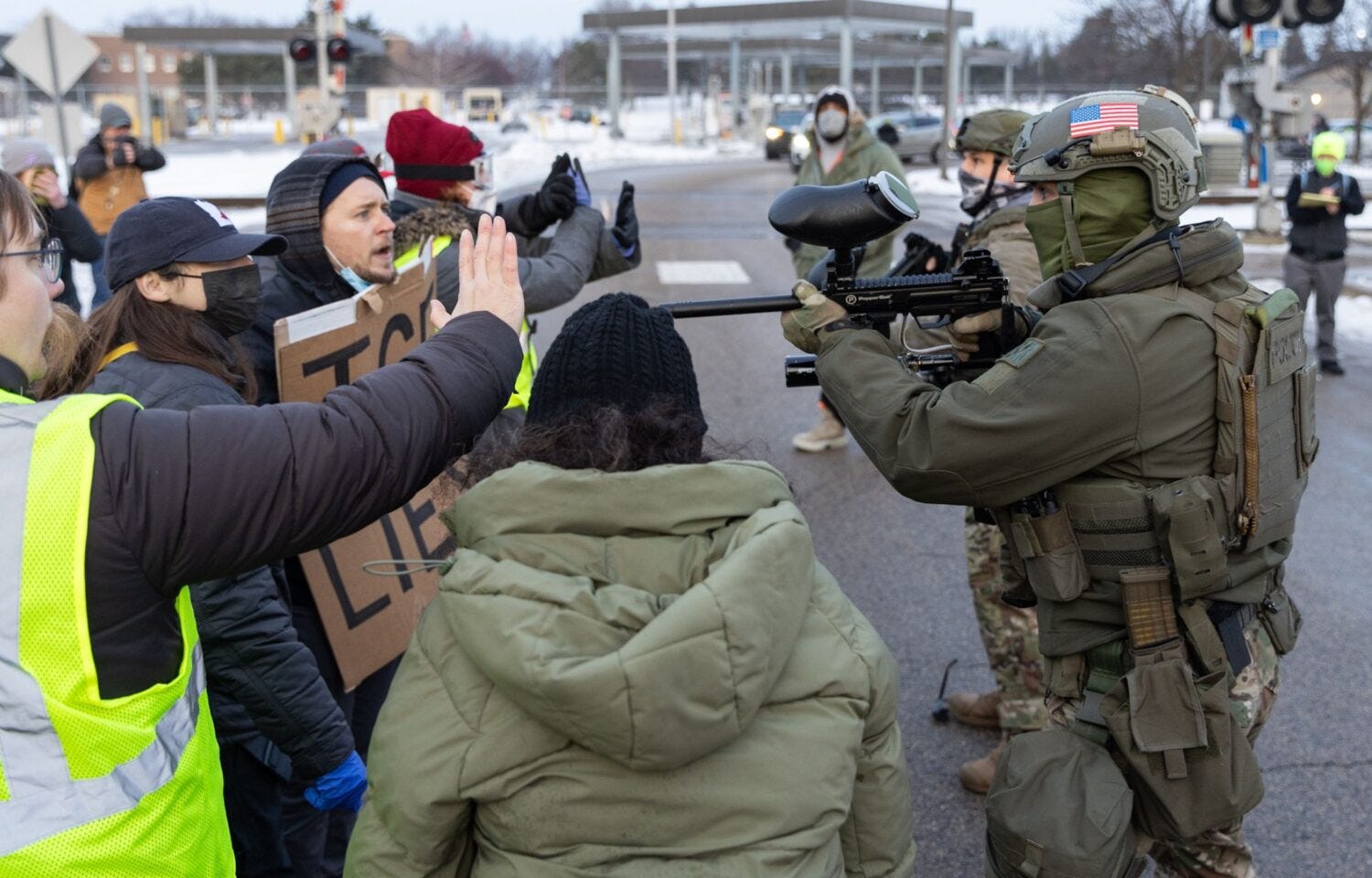
People are calling ICE raids terrorism. Is that hyperbole, or does the conduct actually fit the legal definition under existing state law? And if it does, can prosecutors bring charges? This piece examines what state domestic terrorism laws actually say, lines up their requirements against documented ICE tactics, and lays out what would need to happen for state attorneys general to charge federal agents under these laws. If the argument holds up, readers will find contact information for their state attorney general at the end, along with the specific laws to cite when making the case that prosecution can work and needs to happen.
Advocates and officials have started using the word. Human Rights Watch described the Los Angeles raids as "terrorizing entire communities" in its November report.¹ Psychologists working with immigrant communities say they're treating mass trauma.² Illinois Attorney General Kwame Raoul's lawsuit describes the enforcement campaign as "violent terror targeted at the state and its residents."³ Cook County State's Attorney Eileen O'Neill Burke says ICE has unleashed "an untold amount of terror" on communities.⁴
These officials are using "terror" to describe what's happening to people, not to make a legal argument. But the words they've chosen line up, almost exactly, with what state terrorism laws actually say. Thirty-two states have these laws on the books.⁵ Most define the crime the same way: committing a serious crime with the goal of scaring a civilian population into submission or forcing a government to change its policies through fear.⁶ The language comes directly from 18 U.S.C. § 2331(5), which Congress passed after September 11, 2001.⁷ State legislators copied it almost word for word.
These laws don't require a connection to a foreign country. They don't require political or religious motivation. They don't care whether the person committing the crime wears a badge. What matters is intent: did the person commit the underlying crime in order to terrorize a population or force a government's hand?
The crimes that trigger these terrorism charges include assault, holding someone against their will, threatening physical harm, putting people in danger, and using threats to force compliance.⁸ ICE agents have been accused of every one of these, in documented incidents across multiple states, over the past year. Masked agents in unmarked cars have detained U.S. citizens with no legal basis.⁹ Agents have carried out military-style raids on apartment buildings, holding residents at gunpoint for hours, separating children from their parents.¹⁰ DHS's own rules prohibit shooting at moving vehicles except in narrow circumstances, yet agents have shot and killed people in situations state officials call unjustified.¹¹
Intent is where this argument picks up real traction. Prosecutors usually struggle to prove what someone was thinking when they committed a crime, but the Trump administration hasn't been subtle. Stephen Miller directed ICE to arrest 3,000 people per day, four times the previous pace, and the administration has publicized its operations specifically to maximize fear.¹² Its stated goal is to deter people through visible, aggressive action in immigrant communities. Schools report 20 percent absenteeism on raid days.¹³ Hospitals report patients skipping appointments for chronic conditions that will kill them if left untreated.¹⁴ Businesses have closed because workers are too afraid to show up and customers are too afraid to leave their homes.¹⁵ The administration doesn't deny any of this. It celebrates these outcomes as proof the policy works.
When officials design a policy to make an entire population afraid to leave their homes, and then publicly celebrate the fear they've created, the intent requirement in state terrorism laws starts to look less like a stretch and more like a confession.
Federal officials claim their agents can't face state criminal charges. Vice President Vance has asserted that ICE agents have "absolute immunity."¹⁶ DHS Secretary Noem has claimed states have "no jurisdiction."¹⁷ Stephen Miller has told agents they're shielded from consequences as long as they're doing their jobs.¹⁸
They're wrong. Federal agents don't get blanket protection from state prosecution. Over a century ago, the Supreme Court settled this: working for the federal government "does not secure a general immunity from state law while acting in the course of his employment."¹⁸ For agents to claim this protection, they have to show two things: that they were doing something they were actually authorized to do, and that they did it in a way that was reasonably necessary to carry out their federal duties.¹⁸ When agents go beyond their authority, act unreasonably, or break federal law themselves, that protection vanishes.
States have charged federal agents with murder, assault, and other violent crimes since the early 1800s.¹⁸ These cases came in waves during periods of intense conflict between state and federal power, including fights over slavery, Prohibition, and desegregation.¹⁸ Minnesota Attorney General Keith Ellison has already launched an independent investigation into a January shooting after federal authorities blocked state investigators from accessing evidence.¹⁸ The legal foundation for states to charge federal agents exists because the people who wrote the Constitution understood that federal power needs a check.
The real power of state prosecution is simple: the president can't pardon a state conviction. The Justice Department can't bury a state investigation. Because states and the federal government operate as separate legal systems, when a state charges someone under its own criminal laws, the president has no power to make it go away.¹⁹ An ICE agent convicted of terrorism in New York or California or Illinois would serve state time regardless of what Trump does.
Ten states could realistically file these charges. New York's terrorism law defines the crime as committing a violent felony with the goal of scaring a civilian population.⁶ California, Illinois, Michigan, Massachusetts, Minnesota, New Jersey, Colorado, Washington, and Oregon all have similar laws on the books and attorneys general who've shown they'll take the federal government to court.²⁰ Several have set up online portals where the public can report crimes committed by federal agents, and they've openly invited people to submit evidence.²¹ The groundwork for coordination already exists. Eighteen attorneys general signed onto a joint legal brief in the Perdomo v. Noem case challenging ICE tactics in Los Angeles.²² Illinois filed its own separate lawsuit calling the enforcement campaign an attack on the state's authority.³
The obvious counterargument is that legislators wrote these laws for al-Qaeda, not for federal agents. But the laws themselves don't say that. They say "intimidate or coerce a civilian population." They say "influence the policy of a unit of government by intimidation or coercion." If masked men in unmarked cars are detaining people off the street and an entire community is too afraid to send their kids to school, the conduct either fits that definition or it doesn't. Nowhere in the text does the law ask who committed the crime. It asks what they did and why.
One state filing charges against ICE agents gives the administration a fight it can win. The full weight of federal legal resources comes down on one attorney general, one state court system, one set of charges. Ten states filing at the same time turns that equation on its head. ICE has roughly 20,000 total personnel.¹² The administration is already stretched thin trying to meet Miller's arrest quotas.¹² If ten states filed terrorism charges in the same month, against different agents for different incidents under different state laws, the federal government simply doesn't have the capacity to respond. Federal lawyers can't fight to move all those cases out of state courts in ten places at once. The administration can't retaliate against ten states simultaneously. Threats lose their power when they'd have to be aimed everywhere at once.
Nothing about this is radical, and the framers would have recognized it immediately. The whole point of federalism is that states can push back when the federal government goes too far. Hamilton wrote in Federalist 28 that when one level of government invades the people's rights, they "can make use of the other as the instrument of redress."²³ The Ninth Circuit has cited that passage in cases dealing with exactly this kind of federal overreach.¹⁸ The framers built two separate systems of criminal law, state and federal, for precisely this situation: a federal government acting lawlessly while federal institutions refuse to hold anyone accountable. States hold criminal authority the president can't touch.
The argument against acting is familiar: it'll fail; it'll provoke retaliation. But holding back has never convinced an authoritarian government to ease up. Deference doesn't produce restraint. It produces escalation. This administration will keep pushing until it hits a wall it can't get past, and state criminal prosecution is one of the hardest walls in American law.
State charges aren't the only legal danger these agents face. Federal law cuts even deeper. 18 U.S.C. § 241 makes it a crime for two or more people to conspire to hurt, threaten, or intimidate anyone exercising their constitutional rights.²⁴ A companion law, 18 U.S.C. § 242, applies the same penalties to any person who, while carrying government authority, deliberately strips someone of their constitutional rights.²⁵ Section 241 also specifically covers people going "in disguise on the highway, or on the premises of another" to stop someone from exercising those rights. Masked agents in unmarked cars, running coordinated operations across the country, fit that description exactly.
The penalties get worse as the harm gets worse. A basic violation carries up to a year in prison; bodily injury or use of a dangerous weapon raises it to ten.²⁴ But when someone dies as a result of these crimes, or when the acts include kidnapping or an attempt to kill, the punishment rises to life in prison or death.²⁴ People are dying. They're dying in raids. They're dying in detention camps from freezing temperatures, starvation, and medical neglect. Every death that comes from this coordinated campaign exposes every person in the conspiracy to the death penalty under federal law, and every agent whose individual actions contributed to a death faces that same exposure personally.
This administration won't charge its own agents. That's precisely why state prosecution matters. The federal exposure doesn't disappear, and it will follow these agents for the rest of their careers, but we can't wait for a future Justice Department to act on it. States can act today, under their own laws, with tools no president can override. Every state terrorism charge filed now adds pressure the administration has to answer immediately, and it puts every agent in the country on notice that someone is watching and someone will prosecute.
This country was founded on one idea above all others: government answers to rules. That's what separates a republic from a monarchy, a nation of laws from a protection racket. The people who wrote the Constitution understood that power corrupts, that officials will overreach, that those in power will turn the machinery of government against the very people it exists to serve. They built a system to hold power accountable even when the people holding it insist they're above accountability. The agents carrying out these operations aren't soldiers in a war. They're employees on a payroll, and the bill always comes due.
We don't need one governor standing on courthouse steps. We need tens of millions of Americans demanding that their elected attorneys general criminally arrest and prosecute the right-wing extremists spreading disinformation to justify these raids, the agents serving as their private political army, and the GOP leadership directing the entire operation. We will prosecute. We will charge. We will oppose this on every front, because self-government demands exactly that. The states that built this country retain the power to enforce their own criminal laws against anyone who breaks them, including agents of a federal government that has forgotten the limits of its authority.
If you believe your state attorney general should explore terrorism charges against ICE agents operating unlawfully in your jurisdiction, contact their office. Below are the relevant state terrorism statutes and attorney general contact links for the ten states best positioned to act.
Ten-State Action Guide: Statutory Citations and Attorney General Contacts
New York
Statute: N.Y. Penal Law § 490.25 (Crime of Terrorism). Under this law, a person commits terrorism when, with the goal of scaring a civilian population or forcing a government to change course through fear, that person commits a serious violent crime. The crimes that qualify include assault, holding someone against their will, and putting people in danger.
Attorney General: Letitia James | Contact: https://ag.ny.gov/contact-attorney-general | ICE Report Portal: https://ag.ny.gov/report-ice-violations
California
Statute: Cal. Penal Code § 422 (Criminal Threats). California also has the Hertzberg-Alarcon California Prevention of Terrorism Act (Penal Code §§ 11415-11419). Prosecutors can combine criminal threat charges with assault and unlawful detention laws when agents use terroristic methods.
Attorney General: Rob Bonta | Contact: https://oag.ca.gov/contact | ICE Report Portal: https://oag.ca.gov/immigrants/report
Illinois
Statute: 720 ILCS 5/29D-14.9 (Terrorism). Under this law, a person commits terrorism when, with the goal of scaring a significant portion of a civilian population, that person knowingly carries out a terrorist act within Illinois. Class X felony carrying sentences from 20 years to life.
Attorney General: Kwame Raoul | Contact: https://ag.state.il.us/contact | Note: AG Raoul has already filed suit against DHS describing enforcement as "violent terror."
Michigan
Statute: MCL 750.543b et seq. (Michigan Anti-Terrorism Act). The law defines an "act of terrorism" as a willful and deliberate act that would qualify as a violent felony, that the person knows puts human lives in danger, and that aims to scare a civilian population or force government action through fear. Punishable by life in prison.
Attorney General: Dana Nessel | Contact: https://www.michigan.gov/ag/contact
Massachusetts
Statute: M.G.L. c. 269, § 14B (Terroristic Threats). Massachusetts makes it a crime to issue threats with the goal of terrorizing people. Prosecutors can bring additional charges for assault, kidnapping, and civil rights violations when federal agents go beyond what the law allows.
Attorney General: Andrea Campbell | Contact: https://www.mass.gov/how-to/file-a-complaint-with-the-attorney-generals-office
Minnesota
Statute: Minn. Stat. § 609.714 (Terroristic Threats). Minnesota makes it a crime to threaten violence when the purpose is to terrorize people or cause serious public disruption. Prosecutors can combine these charges with assault and civil rights laws.
Attorney General: Keith Ellison | Contact: https://www.ag.state.mn.us/contact | Note: AG Ellison has launched an independent investigation into a fatal ICE shooting.
New Jersey
Statute: N.J.S.A. 2C:38-2 (Terrorism). A person commits terrorism when that person commits, attempts, conspires, or threatens to commit any of the crimes listed in the law with the purpose of scaring a civilian population or forcing government policy changes through fear. First-degree crime carrying 30 years to life.
Attorney General: Matthew Platkin | Contact: https://www.njoag.gov/contact/
Colorado
Statute: C.R.S. § 18-9-122 (Terrorist Training Activities) and related laws. Colorado imposes harsher penalties for crimes committed with the goal of scaring a civilian population.
Attorney General: Phil Weiser | Contact: https://coag.gov/contact-us/
Washington
Statute: RCW 9A.46.020 (Harassment/Threats to Kill) and RCW 70.74.270 et seq. (Terrorist Acts). Washington prohibits death threats and threats of injury, and imposes harsher penalties for acts aimed at scaring civilian populations.
Attorney General: Nick Bonta| Contact: https://www.atg.wa.gov/contact-us | Note: AG Ferguson has been among the most aggressive in challenging federal immigration enforcement.
Oregon
Statute: ORS 163.150 (Intimidation). Oregon passed domestic terrorism provisions in 2023. The state's sanctuary law (ORS 181A.820) bars the use of state resources for immigration enforcement.
Attorney General: Dan Rayfield | Contact: https://www.doj.state.or.us/contact-us/
Wondering what else you can do?
Check out the Intro to Soft Secession Booklet and the Oppositional Federalism Booklet along with pro-democracy merch at TheExistentialistRepublic.com
Anything I write is available for free, including those booklets, at BuyMeACoffee.com/TheER along with the "Grab Them By the EARR: How to get politicians to do what you want" training guide among other free items in the shop.
References
¹ Human Rights Watch. (2025, November 4). US: ICE abuses in Los Angeles set stage for other cities. https://www.hrw.org/news/2025/11/04/us-ice-abuses-in-los-angeles-set-stage-for-other-cities
² Sanchez, L. (2025, June 16). A psychologist unpacks how ICE raids traumatize communities. The 19th. https://19thnews.org/2025/06/ice-raids-los-angeles-mental-health/
³ Illinois Attorney General. (2026, January). Attorney General Raoul files lawsuit against Trump administration over illegal and retaliatory immigration enforcement tactics. https://illinoisattorneygeneral.gov/
⁴ WBEZ Chicago. (2026, January 9). Can state officials prosecute the feds? Calls grow after Minneapolis shooting. https://www.wbez.org/
⁵ International Center for Not-for-Profit Law. (2024, August 29). State domestic terrorism laws in the United States. https://www.icnl.org/resources/terrorism-laws-in-the-united-states
⁶ New York State Senate. (n.d.). Penal Law § 490.25: Crime of terrorism. https://www.nysenate.gov/legislation/laws/PEN/490.25
⁷ Legal Information Institute. (n.d.). 18 U.S.C. § 2331(5): Definition of domestic terrorism. Cornell Law School. https://www.law.cornell.edu/uscode/text/18/2331
⁸ Daniels, L. (2023, January 18). Prosecuting terrorism in state court. Lawfare. https://www.lawfaremedia.org/
⁹ California Attorney General. (2025, July 12). Attorney General Bonta: ICE and CBP must end unlawful practices in Los Angeles immediately. https://oag.ca.gov/
¹⁰ CNN. (2025, October 3). Chicago apartment ICE raid: Tenants detained for hours and American kids separated from parents. https://www.cnn.com/
¹¹ FOX 9 Minneapolis-St. Paul. (2026, January 7). Can ICE agents shoot at moving vehicles? Yes and no. https://www.fox9.com/
¹² HIAS. (2025, June 27). The ICE raids: What you need to know. https://hias.org/
¹³ CNN. (2025, December 5). When the feds come to town: In cities targeted by Trump's immigration crackdown, a shared playbook emerges. https://www.cnn.com/
¹⁴ Mississippi Today. (2025, December 22). As ICE raids inspire fear in immigrant communities, some people in Mississippi are skipping health care. https://mississippitoday.org/
¹⁵ NPR. (2025, June 10). The Los Angeles ICE raids are changing how immigrant communities go about their lives. https://www.npr.org/
¹⁶ Newsweek. (2026, January 8). JD Vance says ICE agent has "absolute immunity" after Minneapolis shooting. https://www.newsweek.com/
¹⁷ CBS News. (2026, January 9). Noem defends ICE officer who shot woman in Minneapolis as having "followed his training." https://www.cbsnews.com/
¹⁸ Godar, B. (2025, November 6). Are federal officials immune from state prosecution? Lawfare. https://www.lawfaremedia.org/article/are-federal-officials-immune-from-state-prose
¹⁹ Gamboa v. Trump, No. 4:25-cv-163 (S.D. Tex. 2025) (discussing dual sovereignty doctrine and presidential pardon limitations in context of state criminal proceedings).
²⁰ National Association of Attorneys General. (2025). State attorneys general actions on immigration enforcement. https://www.naag.org/
²¹ California Attorney General. (2025). Report immigration enforcement misconduct. https://oag.ca.gov/immigrants/report
²² Perdomo v. Noem, No. 25-cv-1234 (C.D. Cal. 2025) (amicus brief filed by eighteen state attorneys general).
²³ Hamilton, A. (1787). Federalist No. 28. In The Federalist Papers.
²⁴ Legal Information Institute. (n.d.). 18 U.S.C. § 241: Conspiracy against rights. Cornell Law School. https://www.law.cornell.edu/uscode/text/18/241
²⁵ Legal Information Institute. (n.d.). 18 U.S.C. § 242: Deprivation of rights under color of law. Cornell Law School. https://www.law.cornell.edu/uscode/text/18/242
This is a bit off topic but also somewhat related. I don’t know if you are following the news of AZ’s AG Kris Mayes, a Democrat. She was on a recent podcast and stated that AZ has a “stand you ground law” one of the most liberal stand your ground laws in the country, passed by the Republicans in the AZ state legislature. She pointed out on the podcast that because of this very liberal law that allows just about anyone who “feels their life threatened” by anyone else, given certain circumstances, they have a right to shoot to kill. She said this is a law that could cause harm to ICE barging into peoples’ homes, masked, no ID, no uniforms, in unmarked cars that could turn into a blood bath if a person, resident of a home, felt threatened. She was issuing a siren call and a warning that people could get killed.
But what happened after her words were spoken? The MAGA republicans in AZ went after her, said she should be impeached and was disgracing our state because she was encouraging people to shoot and kill ICE. It is a lie, she never encouraged anyone to kill ICE or any police or authority. She was stating the law and the consequences of the law in this kind of volatile situation with ICE. They are simply MAGA out of control but she says she will not back down, that her words are correct, that the law can cause people harm and that she was warning of the problems that can occur. This morning in the AZ Daily Star, now the Democratic Governor, Katie Hobbs is siding with the MAGA Republicans and telling Mayes that she spoke inappropriately and needs to take back her words.
Imagine that, the Governor thinks Mayes is “inappropriate “ as ICE agents kill citizens on the streets of Minneapolis and as they also are infusing their rogue lawlessness in Tucson and elsewhere.
Have sent the following letter to my AG
I am writing to demand clear, public, and immediate action from your office: New Jersey law must be enforced in New Jersey — without exception, without hesitation, and without special immunity for federal immigration or border enforcement personnel.
If any ICE or Border Patrol agent violates N.J.S.A. 2C:38-2 or any other applicable New Jersey criminal statute while operating in this state, they must be investigated and, where the evidence supports it, prosecuted.
A federal badge is not a license to disregard state law, civil rights, or basic legal limits on government power.
Failure to enforce state law in these situations sends a dangerous message — that some armed agents can operate above the law inside our communities.
That erodes public trust, weakens the rule of law, and puts residents at risk. New Jersey cannot claim to value civil rights and public safety while looking the other way when violations are committed by federal personnel.
Your office has both the authority and the responsibility to act. I urge you to:
Issue an explicit public statement that New Jersey criminal laws apply fully to federal agents acting within the state
Direct county prosecutors to treat alleged violations by ICE or Border Patrol agents the same as they would any other suspect
Ensure prompt, independent, and transparent investigations of credible complaints
Pursue charges under N.J.S.A. 2C:38-2 and any other relevant statutes wherever the facts and law support them
No one should be functionally immune from accountability in New Jersey. Equal justice under the law only means something if it is enforced, especially when the alleged misconduct involves government agents with the power to detain, search, and use force.
I expect your office to uphold New Jersey law decisively and without deference to federal pressure or politics.
Sincerely,