


If you get a chance, check out The Existentialist Republic’s extensive library of booklets, training guides, and books on effective activism, citizen lawfare, and reducing Elon Musk’s net worth, among many other subjects covered. Everything we publish is available as a free PDF so that activism never sits behind a paywall.
Thomas Massie and Bill Cassidy lost their Republican primaries within four days of each other in May 2026, Cassidy in Louisiana on the 16th and Massie in Kentucky to Ed Gallrein, whom the president recruited and endorsed. The party’s conservative critics have an answer for results like these. George Will gave it on Firing Line in September 2021: “there’s no place right now for conservatives in the Republican Party.” On that account the people running the party are not real conservatives, and the word conservative names a real tradition they have abandoned.
What makes someone a real conservative? The question assumes the word conservative has an essence, a true nature a person must have to count as one. A triangle has an essence: three straight sides. A shape without them is not a triangle. Philosophers call this essentialism, and they call the opposite view nominalism. Nominalism says most of our categories have no essence at all. Take a weed. No true nature makes a plant a weed. A weed is just a plant someone has decided they do not want, so the same plant is a weed in one yard and welcome in the next. The word is a label we put on a group, nothing more.
So which is conservatism? Kirk and Oakeshott wrote a definition down, the disposition “to prefer the familiar to the unknown”, but a definition on paper is not an essence in the world. There is no true conservatism apart from the actual conservatives, so “they are not real conservatives” has nothing underneath it. What is left is what those conservatives do. About 84 percent of Republicans have approved of the president across his second term, and the few officials who cross him are expelled. That is what the word conservative now names.
George Will worked on Reagan’s 1980 campaign, and Bill Kristol was chief of staff to Reagan’s education secretary from 1985 to 1988 before co-writing The War Over Iraq in 2003. Neither called the party lost to conservatism during Reagan’s deficits or the Iraq war. Their verdict arrived in 2016 because they were fine with everything before that.
The magazine that organized the movement drew the bounds of membership. National Review’s editorial of August 24, 1957, “Why the South Must Prevail,” asked whether the white South was entitled to keep power where it lacked a majority and answered yes, because “for the time being, it is the advanced race.” William F. Buckley Jr. denounced Robert Welch in 1962 for calling Eisenhower a communist agent, and read the John Birch Society out of the movement in 1965 after their leadership opposed the Vietnam War as a communist plot. Buckley’s rule, in his words, was that “There are bounds to the dictum, Anyone on the right is my ally.” The bounds excluded Welch and the Birchers but never the racism of that 1957 editorial.
Reagan gave the first speech of his general election campaign on August 3, 1980, at the Neshoba County Fair in Mississippi, near where three civil rights workers were murdered in 1964, and told the crowd, “I believe in states’ rights.” A year later Lee Atwater, by then on Reagan’s White House staff, described on tape how the party had learned to reach the same white voters with economic language instead of racial slurs, and said of the tax cuts, “a byproduct of them is, blacks get hurt worse than whites.”
Reagan’s two terms cut the taxes of the highest earners and raised the burden on people paid by the hour. The top income tax rate fell from 70 percent to 28 percent across the 1981 and 1986 acts. The 1983 amendments Reagan signed taxed Social Security benefits for the first time, and the payroll tax that funds the program stops at a wage cap. The gross federal debt went from $962 billion to $2.74 trillion in eight years without a war. The movement’s verdict on that record is the phrase “Reagan Republican,” still claimed as a credential 40 years later.
Steven Levitsky and Daniel Ziblatt named the mechanism in How Democracies Die. Established parties are the gate, and democracies fall when those parties open it to an outsider they mean to use. Italy’s establishment feared the socialists more than the fascists, and in October 1922 the king appointed Mussolini rather than break the march on Rome. Eleven years later German conservatives made the same bet, persuading Hindenburg to make Hitler chancellor on January 30, 1933; Franz von Papen, who engineered it, said they had hired him and would box him in within two months. The pattern outlived the era.
The state that came through the gate watched and jailed its own people every time. Mussolini built a secret police, Hitler built the Gestapo, Maduro jailed Venezuela’s opposition, and Orbán turned spyware on Hungary’s journalists. It should be noted in fairness, that Belgian and Finnish conservatives shut out their own fascist parties in the 1930s while American party leaders kept Henry Ford, Huey Long, Joseph McCarthy, and George Wallace from ever winning a nomination. Gatekeeping against autocrats is a choice, and the American conservative movement went in the other direction.
Robert Paxton wrote the standard history of fascism, and for years he refused to call the president a fascist. January 6 changed his mind. Days after the attack, in Newsweek, he wrote that it “removes my objection to the fascist label.” Jason Stanley, the author of How Fascism Works, left Yale for Toronto in 2025 because he would not raise his children in a country tilting toward fascist dictatorship. The American movement made that man their nominee. Where the German and Italian conservatives lost control of the leader they installed, the American conservatives kept discipline over their own ranks, and they have not let up. Bob Bennett, Mike Castle, Bob Inglis, and Lisa Murkowski all lost Republican nominations in 2010 to challengers from the right, and Murkowski kept her seat only by write-in. Richard Lugar lost his Indiana primary in 2012, and Eric Cantor, the House majority leader, lost his in 2014. Jeff Flake and Bob Corker did not run again in 2018 rather than face primaries. Mark Sanford lost his House primary in June 2018 hours after the president urged voters to remove him.
Of the 10 House Republicans who voted to impeach the president after January 6, four lost primaries to challengers he endorsed and four retired rather than run again; Dan Newhouse announced in 2025 he would not run again, which leaves David Valadao the last of the 10 still running. Marjorie Taylor Greene resigned effective January 5, 2026 after the president withdrew his endorsement over her sponsorship of the discharge petition on the Epstein files. Massie and Cassidy followed in May, alongside the Indiana Republican state senators who blocked his redistricting map, and Massie’s race alone drew $32.6 million in advertising, the most of any House primary in history.
The party removes the members who cross the president, and the voters keep him in office. Matthew Graham and Milan Svolik found in 2020 that only about 3.5 percent of Americans will abandon their own party’s candidate to punish a breach of democratic rules.
Frank Wilhoit put the record in one sentence in 2018: “There must be in-groups whom the law protects but does not bind, alongside out-groups whom the law binds but does not protect.” The advanced-race editorial and the states’ rights speech are that proposition written as policy. The expulsions are the same proposition applied to membership. The member who votes to release the Epstein files is out; along with any member who dares to disagree with the president.
If defined by resounding consensus and the totality of their conduct, most of those who call themselves a conservative in 2026 America submit to total commitment to whatever Donald Trump says is the truth.
Want to do something about it? Check out the ER Library of free effective activist training materials.
But just so you know, that only happens if we have new subscribers EVERY ARTICLE. 9 out of the last 10 articles we published fell beneath the 10 subscriber threshold we try to meet so that the publication can continue. We are talking less than $0.22 per day so that the Existentialist Republic can continue finding ways to disempower the fascists and empower the people. Don’t let this be the reason you skip a meal or miss rent. But if you can, please be an activist subscriber. - Chris
The Existentialist Republic Library
You can get a FREE PDF of the book in the BMAC shop for $0.00 by clicking on this sentence.
Conservatism: America’s Personality Disorder — physical copy / free download
Intro to Soft Secession — physical copy / free download
Oppositional Federalism and You — physical copy / free download
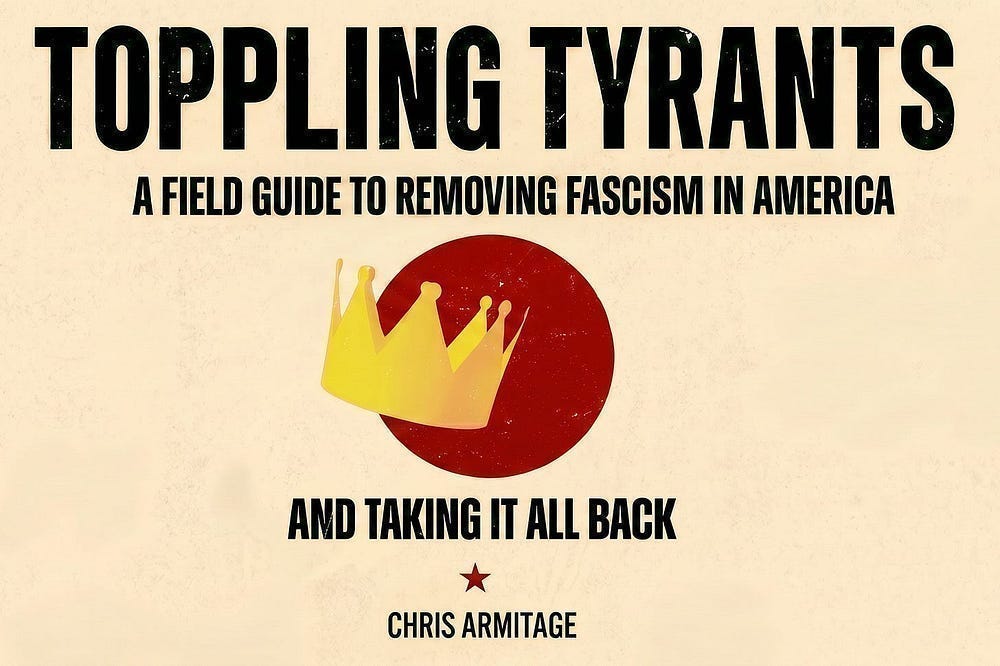
Toppling Tyrants: A Field Guide to Dismantling American Fascism — physical copy / free download
Grab Them By The E.A.R.R.: How to Get Politicians to Do What You Want — physical copy / free download
Being Dangerous: Go From Activist to Operative
More Free downloads:
Soft Secession: 100 Policies That Pass
All Four Completed Model Legislation Bills
The Opposition Guide to Tax Warfare
Six-Panel Soft Secession Brochure
This should be a pamphlet to hand out to the many “Reagan republicans “ and those following in those footsteps….and a warning about political affiliations in general that require only understanding the most superficial meanings of the thing you are signing up for.
There is a version of this for corporate dems.
Vote progressive but don’t stop paying attention!
Sclerotic ideas are dangerous.
The Republican Party We See Today Didn’t Happen Overnight.
What we have today in the Republican Party has roots that go back decades, including the political realignment that took place during the Reagan era. Over the years, those forces have continued to grow and evolve into what we see today.
A Republican Party increasingly willing to embrace policies and rhetoric that critics argue promote white supremacy, undermine equal rights, and concentrate power in the hands of one leader.
We are witnessing a political movement where loyalty to Trump is too often placed above loyalty to the Constitution, the rule of law, and the American people.
This is not simply a disagreement over conservative policies. It is a debate about the future of our democracy, the protection of individual rights, and whether our government serves all Americans or only those who hold power.
We cannot ignore how we got here, and we cannot allow the erosion of democratic institutions to continue unchecked.
The November midterm elections are an opportunity for voters to make their voices heard. Support candidates who will defend the Constitution, protect voting rights, and hold government accountable.
Our democracy belongs to all of us—not to one party, one leader, or one political movement.
Reagan’s presidency was a major turning point in the modern Republican coalition, but the history is more complicated than attributing today’s entire party to Reagan alone. The Republican Party’s evolution also involves earlier civil-rights realignment, the rise of the religious right, and later developments in conservative politics.