
Clarence Thomas Could Be Charged With Felony Tax Fraud in Virginia on Monday
Sufficient evidence exists in the public record.

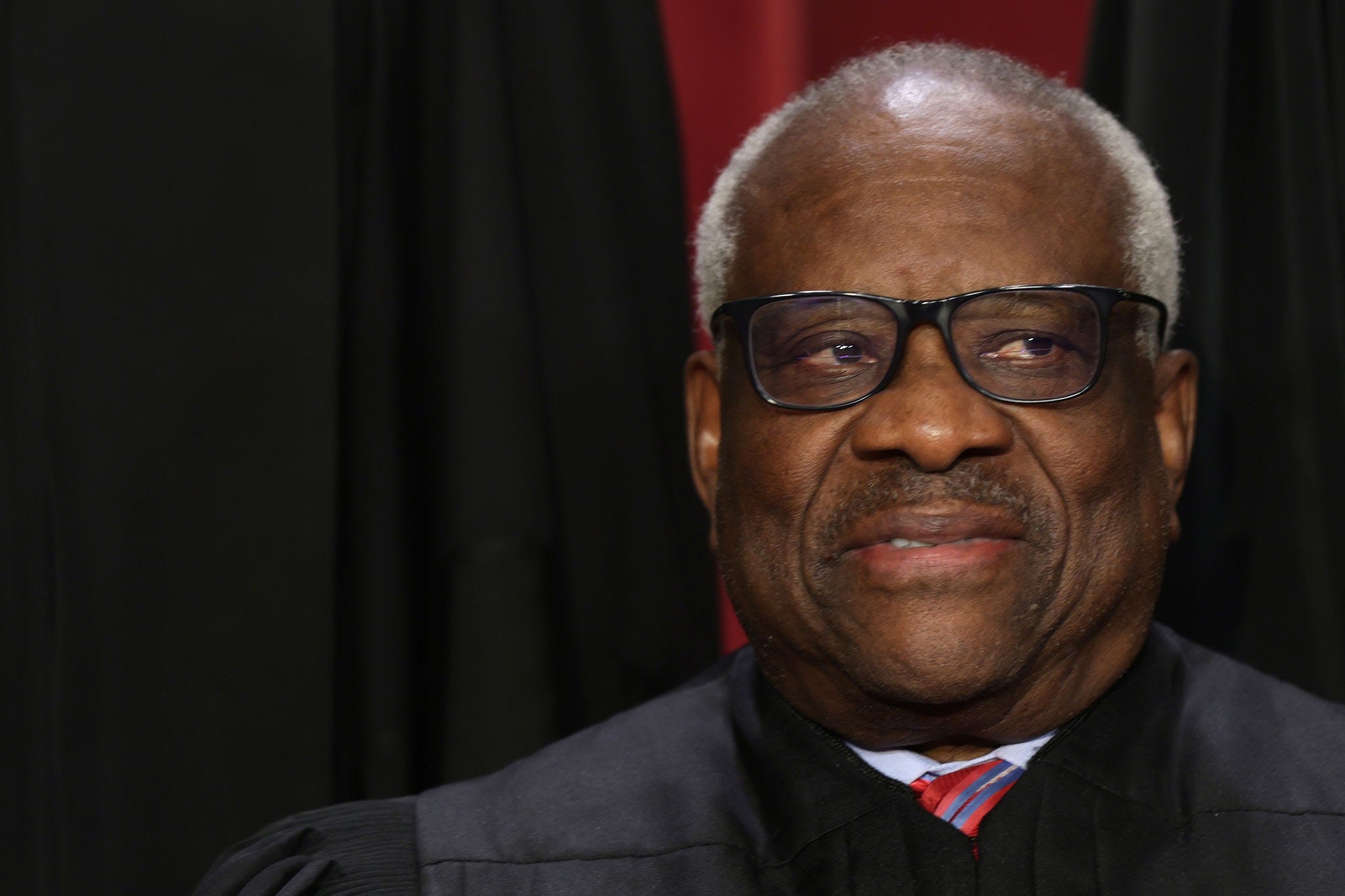
A note before we begin. Below you will find three things: an article laying out the case, a daily call to action built so your two minutes actually land, and a list of free resources from the Existentialist Republic team. Read the first, act on the second, take what is useful from the third.
For years, Clarence Thomas has been showered with gifts. Flights on a billionaire’s private jet, lavish vacations cruising on his superyacht, summer stays at his Adirondacks compound, tuition for a child Thomas was raising, a quarter-million-dollar motorhome a wealthy friend paid for. A reasonable person could look at all of it and wonder whether a justice on that kind of receiving end might be inclined to side with the wealthy, powerful, and conservative interests that keep appearing before his Court. That is a fair question, but it is not the question this article asks.
This article asks something narrower. Set the influence aside. Those gifts were income, and income belongs on a tax return. Thomas treated them as nothing, and no public record shows he ever reported a dollar of it. Under Virginia law, leaving income that size off a return, if it was done to cheat the state, is a felony. The evidence is already public, and he could be charged on Monday. First, the charge itself.
I ran this past attorneys I trust, and off the record their read matched the one that follows. The tax count is the one a serious lawyer wouldn’t dismiss. Conviction is not the reason. The reason is that the threshold question, whether a chargeable case exists, is genuinely arguable. The elements are all present. Clarence Thomas lives in Fairfax County, Virginia, and files a Virginia resident income tax return every year. His salary clears the filing threshold many times over. And the gifts that should have appeared as income on those returns sit documented in the donor’s own records, the ones Harlan Crow turned over only when the Senate subpoenaed him, rather than in anyone’s speculation.
Virginia law makes it a felony to file a state income tax return with a false statement on it, made with intent to defraud the Commonwealth. The statute is Virginia Code section 58.1-348, it carries up to five years in prison per count, and the clock has not run out on the returns Thomas filed for tax years 2020 through 2024. That is the whole case, and unlike everything else, it is a case a county prosecutor in Virginia has the plain authority to bring.
Here is how it works. Federal tax law lets you receive a true gift without paying tax on it, but the Supreme Court itself decided in 1960, in a case called Commissioner v. Duberstein, that a transfer counts as a tax-free gift only when it springs from what the Court called detached and disinterested generosity. A politically active billionaire, whose business and ideological interests ride on what the Court decides, who entered Thomas’s life only after Thomas reached the Court, and who kept the benefits flowing year after year for two decades, is a hard fit for detached and disinterested. A jury gets to decide that, not a defense lawyer and not a press release. And if even one private jet trip or one week at the Adirondacks compound in 2021 or 2022 fails that test, its value was taxable income, it belonged on the federal return, and through the way Virginia ties its tax code to the federal one, it belonged on the Virginia return too. Leaving it off, if a prosecutor can show he did it to defraud the Commonwealth, is the felony.
The intent, the hardest piece to prove, is the easiest to see in the record. Thomas disclosed a Crow flight once, in 1997, then stopped disclosing them for the next twenty years while he kept taking them, and when reporters caught individual trips he amended his forms only for the trips they had already proven and left the rest alone.
This is not a paperwork problem. The last time a sitting federal judge was caught filing false tax returns, the House impeached him for it by a vote of four hundred six to nothing. Harry Claiborne was convicted in 1984, sent to prison, and removed from the bench in 1986, and the members who voted to remove him, every single one of them, understood that a judge who lies on his tax returns has forfeited the trust the office requires. Nobody is going to impeach Clarence Thomas in this Senate, and that is exactly why the Virginia charge matters. The conduct already meets the bar that once cost a federal judge his seat. What is missing is not the seriousness. It is the will to treat him like the last judge who did it.
So why hasn’t anyone charged him? Because the people with the power to do it watched what happens to prosecutors who go after the powerful. Fani Willis brought a case against Donald Trump in Georgia, and his allies spent eighteen months turning her personal life into the story, hauling her into hearings over a consensual relationship until an appeals court removed her and her entire office and the case collapsed. Georgia then passed a law, written with that case in mind, that lets defendants recover their legal costs whenever they get a prosecutor disqualified, which puts a bounty on exactly that kind of dig.
Letitia James got indicted in Virginia over a mortgage technicality worth nineteen thousand dollars, a case so thin that two separate grand juries refused to bring it, and she still has to keep showing up to defend herself. A prosecutor looking at Clarence Thomas sees all of that. They see a wealthy, connected target who will spend whatever it takes to make the prosecutor the subject instead of the crime, and they weigh the years of public money it would burn, the chance their own career ends, and the real possibility of losing a rigged fight anyway. Then they make the rational, lawyerly choice to spend their limited resources elsewhere.
So why Monday? Because there is nothing special about Monday. It is the next day the courthouse opens, the next day a prosecutor could walk this to a grand jury, the same as they could have on any working day for the last several years. For anyone else, this case would already be filed. A person who took an undisclosed quarter-million-dollar windfall and left it off their returns does not get years of patience; they get charged, and the date it happens is just whatever Monday comes next. The only thing standing between Clarence Thomas and that ordinary Monday is the seat he holds. And a seat on the Supreme Court is supposed to raise the standard a person is held to, not hand them an exemption from it. The barrier here was never legal. It is a decision to treat him differently, and that decision can be unmade on a Monday.
There are many good reasons not to pursue Trump, Thomas, and the people like them. The reasons are legitimate and the concerns reasonable. We need to do it anyway, because the alternative is a country with a class of people the law cannot touch, and those people now run it.
That a charge would be hard to win is a separate thing from whether it can be brought, and bringing it has a logic of its own. We show probable cause from the visible conduct, then argue that the visible conduct is itself evidence that compelled discovery will yield more. The donor admitted the gifts only when the Senate subpoenaed him. The trips surfaced years apart as reporters dug. Thomas amended his disclosures only for what investigators had already caught. Each fact, on its own, would mean little. Together they support a reasonable inference that what sits in public view understates what a grand jury would find.
We do not yet know what Thomas actually reported on his Virginia returns, because those returns are not public, and that gap is the point rather than a weakness. The public record alone establishes probable cause, and it represents only what journalists and a Senate committee could pry loose without subpoena power. Nobody has shaken the tree with the tools a real investigation provides, and we have solid reason to believe more falls out when someone does.
So this lands in one place, and it is not Washington D.C. It lands in Fairfax County, Virginia, where Thomas signs and files his return, and where elected officials hold the power to act on it. Three officials can move on this, and they can each do something different, so we ask each one for what they actually have the power to do.
Steve Descano, the Fairfax County Commonwealth’s Attorney, holds the charging power. He can open the investigation, convene a grand jury, and bring the counts, and he happens to be a former federal prosecutor who spent six years in the Justice Department’s Criminal Tax Division, which means the case would reach someone who already knows exactly how to read it. Governor Abigail Spanberger holds a different lever. Under Virginia Code section 2.2-511 she can formally request that the Attorney General take the case up, the request that unlocks state involvement beyond the county. Attorney General Jay Jones can act on that request if it comes, and short of that he can receive a referral and add the weight of his office to the call.
You can contact all three. Ask Descano to open the case before the clock on the 2020 return runs out this spring. Ask Spanberger to make the section 2.2-511 request. Ask Jones to stand ready to take it up. Not one of them answers to the federal apparatus that has shielded Clarence Thomas for thirty years. There is no legal reason this cannot begin on Monday. There is only the decision to treat him like everyone else.
Here is where to reach them, by phone or by email. Steve Descano, Fairfax County Commonwealth’s Attorney: phone 703-246-2776, email through the office contact form at fairfaxcounty.gov/commonwealthattorney, mailing address 4110 Chain Bridge Road, Suite 114, Fairfax, VA 22030. Governor Abigail Spanberger: phone 804-786-2211, email through the contact form at governor.virginia.gov/contact, mailing address P.O. Box 1475, Richmond, VA 23218. Attorney General Jay Jones: phone 804-786-2071, email mailoag@oag.state.va.us, mailing address 202 North Ninth Street, Richmond, VA 23219.
A call or an email takes two minutes, and you do not have to live in Virginia to send one. If you are a Virginia resident, say so, because a constituent’s voice carries the most weight. Everyone else has every reason to write or call as someone who believes the law should apply to all. You can say or write something close to this: “My name is [name]. I’m asking the Commonwealth’s Attorney to open a criminal investigation into whether Justice Clarence Thomas filed false Virginia income tax returns by failing to report years of undisclosed gifts as income. The evidence is public, the conduct falls within the five-year statute of limitations, and no one, however powerful, should be exempt from a law the rest of us have to follow. I’d like my message recorded as supporting that investigation.” For the Governor’s office, swap in a request that she ask the Attorney General to take the case up under section 2.2-511. For the Attorney General’s office, ask that he be ready to act if that request comes. Be brief and be polite. If you are a Virginian, give your town.
One last thing. The last two days in a row, we have come up short of the ten new subscribers a day this publication needs to keep moving. Millions of readers find The Existentialist Republic useful, and we give away more than a dozen books and booklets for free, along with tailored model legislation and published pro-democracy academic reserach. If you can step up today and become an activist subscriber, you are what keeps this alive. Do not let it be the reason you skip a meal or miss rent. But if you find this publication useful and you want to keep the lights on, subscribing is how that happens.
Conservatism: America’s Personality Disorder — physical copy / free download
Intro to Soft Secession — physical copy / free download
Oppositional Federalism and You — physical copy / free download
Toppling Tyrants: A Field Guide to Dismantling American Fascism — physical copy / free download
Grab Them By The E.A.R.R.: How to Get Politicians to Do What You Want — physical copy / free download
More Free downloads:
Soft Secession: 100 Policies That Pass
Being Dangerous: Go From Activist to Operative
All Four Completed Model Legislation Bills
The Opposition Guide to Tax Warfare
Six-Panel Soft Secession Brochure
Prosecution Memo: Jonathan Ross
The Opposition Guide to Tax Warfare
Six-Panel Soft Secession Brochure
Except for this Monday being Memorial Day, everything else is right on. So this coming week, make it Tuesday.
Also have you noticed that a more and more states are stepping up to enact legislation the federal government can’t touch? Both Hawaii and Montana are taking steps to overturn Citizens United, and other states can as well. It’s catching on, Chris, thanks for your efforts!
Being it on! I still believe Anita Hill.