

Ten subscribers per article. That’s what keeps this publication, the model legislation, and this organizing community alive. It works out to around 20–30 cents per article. Otherwise it cannot continue. If this helps, help back. BuyMeACoffee.com/TheER
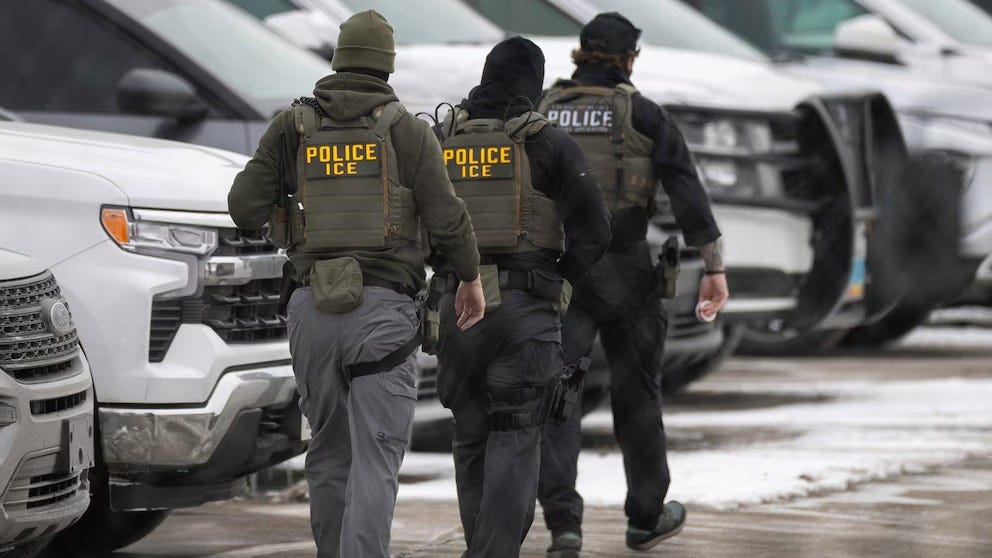
Steve Bannon isn’t subtle. In February, speaking on his podcast, he told his audience that ICE will “surround the polls come November” and described the administration’s deployment of federal agents to airports as a test run to perfect that involvement before Election Day.¹ When reporters asked White House press secretary Karoline Leavitt whether the president planned to send federal agents to polling places, she said she hadn’t heard him discuss formal plans, then added that she “can’t guarantee” an ICE agent wouldn’t be near a polling location in November.² Markwayne Mullin, sworn in as DHS secretary in late March, declined to rule it out at his confirmation hearing.³
The law on this is unambiguous. A federal statute dating to the end of the Civil War prohibits sending “troops or armed men” to any polling place except to repel armed enemies of the United States.⁴ Federal criminal law makes it a crime to intimidate, threaten, or coerce any person to interfere with their right to vote.⁵ An ICE agent carrying a weapon at a polling place is an armed person. Both statutes cover that person. The problem is that enforcing those statutes requires a federal prosecution, and the Justice Department answers to the same president who would be ordering the deployment. States cannot wait for a federal government to prosecute itself. That is why state law, state police, and state attorneys general are the only enforcement track that actually works. If they refuse to perform their lawfully delegated duties, then they are willingly sacrificing the immense and clear constitutional authorities they possess.
Armed agents at polling places have drawn the most attention, but they are one piece of something larger. Maryland Governor Wes Moore said it plainly in late March: “I think these are all tools of how the president is trying to think about a much larger plan, which is if you cannot hold on to power through democratic elections, then adjust democratic elections.”⁶ Adjust is a word you use when you move furniture. What Moore is describing is the systematic dismantling of the conditions that make a democracy possible, and then he uses the language of a polite chiropractor.
In July 2025, Trump directed Texas Republicans to redraw the state’s congressional map to shift five Democratic districts toward his party.⁷ Texas Democrats walked out to break quorum, holding out for two weeks before the maps passed anyway. A federal court ruled the new map an unconstitutional racial gerrymander. The Supreme Court overruled that finding and allowed the map to stand for 2026.⁷ The Brennan Center for Justice concluded that Black and Latino communities in Texas now face the first legislatively enacted reduction in their electoral power since the Voting Rights Act passed in 1965.⁸ Florida Governor Ron DeSantis called a special legislative session for April 2026 to follow the same template, targeting three to five additional House seats. Missouri and North Carolina each claimed a Democratic-held district as well.⁹ California voters approved their own redrawn map in a November special election to counter Texas, and Virginia is moving toward the same response. The old norm against mid-decade redistricting is gone on both sides, which is precisely the point. Before a single federal agent steps near a polling place, Republicans have potentially rearranged seven congressional seats through map-drawing alone.
At the federal level, Trump’s Safeguard American Voter Eligibility Act would require every American to produce a passport or birth certificate to register to vote and would effectively end mail-in voting without an excuse. Critics of the legislation estimate it would affect roughly 21 million citizens who lack ready access to either document.⁶ Louisiana ran a voter roll purge using a federal database assembled by the Trump administration and found 79 questionable registrations out of millions of votes cast in the state since the 1980s.⁶ The purge produced almost nothing. The database still exists, and the federal government is still pushing states to use it.
Each of these moves operates on a different timeline and targets a different part of the process. Redistricting happens in state capitols before the election. Voter roll purges happen in the months before registration deadlines. The credentialing bill happens in Congress. Armed agents happen on Election Day. Together they describe a federal government that has decided an election outcome is too important to leave to voters.
The strategy that actually stops them does not start with legislation. It starts with a governor picking up a pen. Directing state police on how to respond to unidentified armed individuals at public locations sits squarely within normal executive authority in every state. Virginia Governor Abigail Spanberger signed an executive order on election integrity last week without declaring any emergency.¹⁰ The protocol goes into effect the day a governor signs it, and it is far harder to challenge in court than an emergency declaration because it does not touch election administration at all. It is a law enforcement directive. The signs go up. The bodycams roll. The documentation flows to the state attorney general. Legislation reinforces the strategy and adds criminal penalties and civil liability, which is why states should pass it, but no governor needs to wait for a legislature to act first.
New Mexico acted first on the legislative front. Governor Michelle Lujan Grisham signed Senate Bill 264 in March, making her state the first to explicitly prohibit armed federal personnel from standing within 50 feet of a polling place or ballot drop box during any election period. The law gives voters, election workers, and prosecutors the right to sue directly, with courts authorized to impose fines up to $50,000 per violation.¹¹ Virginia passed a 40-foot buffer requirement through its general assembly.¹¹ Bills covering similar ground are moving in California, Connecticut, Pennsylvania, Rhode Island, and Washington.¹¹ Which raises the obvious question: if federal agents show up anyway, the federal government writes a check months later from a budget funded by taxpayers, and the election is already decided, what did the law accomplish? Corporations calculate regulatory fines as the cost of doing what they wanted to do. A fine that arrives after a stolen election isn’t a punishment. It’s a receipt. The strategy below is built on that reality, because civil fines were never going to be enough.
Arizona Republican state Senator Jake Hoffman introduced legislation that would have required every county to sign an agreement with ICE to place federal agents at polling places, early voting sites, and ballot drop boxes for the 2026 midterms.¹¹ A committee hearing was canceled in February, likely killing the bill for now, though it can be revived. Congressional Republicans provided the political cover: object to armed agents at the polls, they argue, and you must be protecting people who shouldn’t be voting.¹² That argument exists to make the illegal look routine, which is the same work Bannon’s airport “test run” language is doing. Both serve the same preparation.
The second layer is a credentialing protocol. Any armed person who cannot or will not identify themselves to local law enforcement at a polling site is not automatically a federal agent. They are an unidentified armed individual at a protected election location, which is a public safety emergency regardless of what they claim. Portland’s city council is currently debating an ordinance built on exactly this principle, establishing what legal scholars call “credible indicia of law enforcement authority” as the standard for verification.¹³ DHS regulations already require ICE agents to identify themselves at the time of any arrest.¹⁴ A state law requiring visible credentials from any armed person within the polling perimeter works with federal law, not against it. Any legitimate law enforcement officer can satisfy that standard in thirty seconds.
The third layer is pre-positioned local police with body cameras running from the moment polls open to the moment they close. States reinforce the protocol with signage posted at every entrance to the polling perimeter. The sign does the legal work before a single word is spoken. It informs any armed person approaching the site that credentials are required, that federal agent status exempts no one from state law, and that violations are being recorded and referred to the state attorney general. You cannot tell a judge you did not know when the sign was at eye level before you took another step. The protocol itself is deliberately calm. Officers approach, ask for credentials, and document the interaction. If the person refuses to produce credentials, that refusal is documented and they are asked to leave. If they produce credentials, they have just handed their name, badge number, and agency affiliation to a body camera already on its way to the state attorney general. “I was following orders” has not been a successful legal defense in any American courtroom since Nuremberg. These agents are welcome to explain that to a judge.
That record goes to the state attorney general the same day. State voter intimidation law is separate from federal voter intimidation law. A state AG prosecution runs entirely on its own authority. The president cannot pardon it, and the federal government declining to enforce its own statutes does not touch that proceeding. States without protective legislation and without governors willing to act have fewer tools. That is the honest answer. The strategy described here only works where the people in power choose to use it.
None of this will look clean. There is no version of November where armed federal agents at polling places, or the response to them, resembles normal democratic life. The goal is to make the ugliness work in the direction of accountability rather than suppression, to ensure that every person who tries to stop an eligible voter from casting a ballot hands their name, their badge number, and their agency affiliation to a camera that is already building a criminal case against them. A University of Cincinnati study examining the 2017 Alabama Senate special election found that police presence at polling places was associated with a 32% reduction in African American participation.¹⁵ Officers should be nearby but not automatically on location, body cameras ready, positioned so that voters do not have to walk past them to cast a ballot. The deterrent is the announced consequence, not the physical presence. A voter who knows the state has a documented response capacity and a criminal prosecution track already running is a voter who might feel safer walking in. The voter who sees a uniform at the entrance may not walk in at all, and that voter is disenfranchised just as surely as the voter turned away at the door.
But we should be honest about the limits of what any of this accomplishes at the polling place level, because the threat does not stop at the door. Red states are not watching this happen. They are participating in it. When voter suppression becomes systematic enough, when courts are partisan enough, when maps are drawn specifically to dilute the votes of Black and Latino communities, you are no longer living in a democracy in any meaningful sense. Many red states crossed that line before this administration arrived. What the administration has done is nationalize the strategy, coordinate it, and add federal muscle and legal coverage to what states were already doing on their own. The result is a structural problem that cannot be solved at the ballot box, because the ballot box is part of what is being dismantled. We cannot outvote a system that is actively preventing us from voting. We cannot win enough Senate seats to convict on impeachment when half the states in the union are running coordinated campaigns to ensure we never hold enough seats to try.
What we can do is what states have always done when the federal government became the threat rather than the guarantor: assert their own authority, build their own systems, and operate independently of whatever the federal government does at any given moment. The polling place protocol described in this piece is oppositional federalism in its most direct form, states using their constitutional authority over law enforcement, criminal prosecution, and election administration to protect their citizens from a federal government that has chosen a side. It is one piece of a larger strategy of constitutional response to federal capture, blue states acting as sovereign counterweights to fascism, during, and after elections, regardless of what any federal official does or does not do. That strategy does not depend on winning the next election. It does not depend on a functioning federal DOJ. It does not depend on the Supreme Court. It depends on governors willing to sign executive orders, attorneys general willing to prosecute, and state legislatures willing to pass laws with real teeth. And a public willing to aggressively demand them all. Demand, not ask.
Those are the people we need to be pressuring right now, and the way to pressure them is to show up with a specific ask. Contact your governor. Tell them to sign an executive order establishing a credentialing protocol at every polling place in your state, pre-position officers with body cameras away from the entrance, post the signs, and publish the full protocol before Election Day. The template exists. New Mexico built it. Virginia reinforced it. The only thing missing in every other state is a governor willing to use the authority they already have.
Find your governor's contact information at usa.gov/state-governor. Tell them exactly what you read here. The people trying to end free elections are already organized. We need to be too.
Ten subscribers per article keeps this alive. We hit that number the last three days in a row for the first time in weeks! That makes 3/30 days to keep this all moving. Twenty to forty free articles a month, model legislation going directly to legislators and activists, a thriving Discord of nearly 1,000 activists, three books and a dozen booklets all given away free. Two to three million monthly readers. Ten subscribers per article funds all of it.
Don’t let this be the reason you miss rent or skip a meal.
For the rest, you can be one of the 10 today and ensure the articles, books, legislation, and training continue for everyone.
Conservatism: America’s Personality Disorder — physical copy / free download
Intro to Soft Secession — physical copy / free download
Oppositional Federalism and You — physical copy / free download
Toppling Tyrants: A Field Guide to Dismantling American Fascism — physical copy / free download
Grab Them By The E.A.R.R.: How to Get Politicians to Do What You Want — physical copy / free download
More Free downloads:
Soft Secession: 100 Policies That Pass
Being Dangerous: Go From Activist to Operative
Soft Secession: 100 Policies That Pass
All Four Completed Model Legislation Bills
The Opposition Guide to Tax Warfare
Six-Panel Soft Secession Brochure
Works Cited
¹ Broadwater, L. (2026, February). Bannon calls for ICE at polls, describes airports as “test run.” CNN.
² Votebeat Staff. (2026, February 26). ICE agents won’t be at polling places this year, a Trump DHS official promises. Votebeat.
³ McMorris-Santoro, E., & Wright, J. (2026). The Trump administration won’t rule out the possibility of federal agents at polls. NOTUS.
⁴ 18 U.S.C. § 592. Troops at polls.
⁵ 18 U.S.C. § 594. Intimidation of voters.
⁶ Corasaniti, N., & Hulse, C. (2026, March 28). Democrats are trying to connect the dots on Trump’s 2026 plan. CNN.
⁷ Saul, S., & Corasaniti, N. (2025, December 8). After Texas ruling, Trump and Republicans head to 2026 with a redistricting edge. NPR.
⁸ Brennan Center for Justice. (2025, December 16). The Supreme Court messes with Texas’s voting map. Brennan Center for Justice.
⁹ Democracy Docket. (2026, March). Virginia vs. Florida: Trump’s redistricting arms race isn’t over yet. Democracy Docket.
¹⁰ Spanberger, A. (2026, March 24). Executive Order 13: Protecting election integrity in Virginia. Office of the Governor of Virginia.
¹¹ Shorman, J. (2026, March 5). Blue states push to ban ICE at the polls amid federal voter intimidation fears. Stateline.
¹² McMorris-Santoro, E., & Wright, J. (2026). The Trump administration won’t rule out the possibility of federal agents at polls. NOTUS.
¹³ Kanal, S. (2026, January). Proposed ordinance targets unidentified federal agents. KATU News.
¹⁴ State Democracy Research Initiative. (2026, February). Can states prohibit federal law enforcement from masking on the job? University of Wisconsin Law School.
¹⁵ Niven, D. (2021). Policing polling places in the United States: The negative effect of police presence on African American turnout in an Alabama election. Democracy and Security, 18(2).
My Governor is Josh Shapiro who is up for reelection this year. I’ve responded to his campaign’s incessant requests for money by saying that my financial support is contingent on the Governor ensuring that our polling places are protected by something more substantial than a handful of lawyers.
Thank you, Chris. So incredibly on point, timely and needed, as always. 💙💙💙🇺🇸🇺🇸🇺🇸